
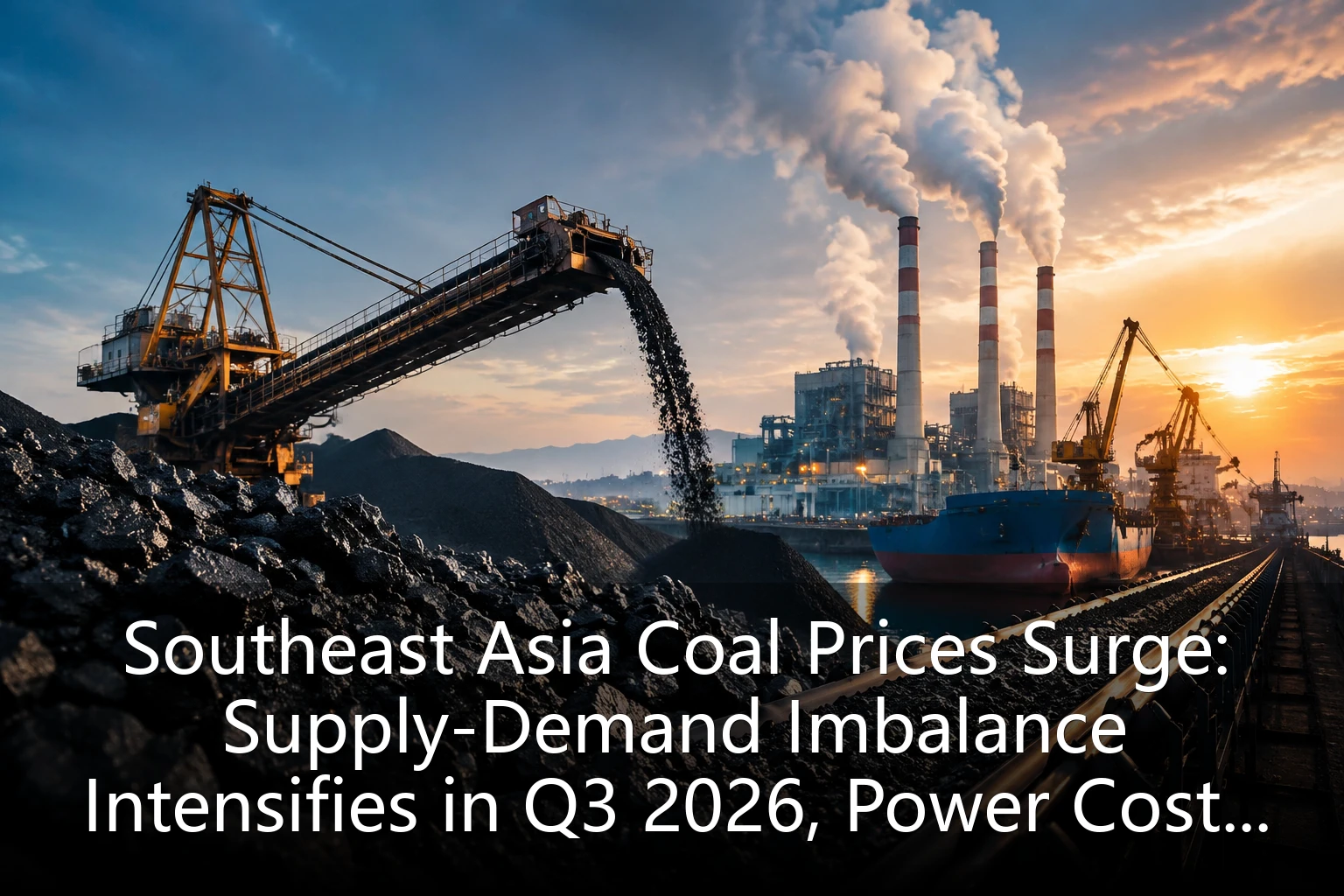
On July 30, 2026, the Southeast Asian coal market experienced a new wave of price increases. According to the latest data from Indonesia's Ministry of Energy and Mineral Resources, the Indonesian thermal coal benchmark price (HBA) has broken through $180/ton, up about 35% from the beginning of the year, hitting the highest level since 2024. Meanwhile, coal landed prices in major importing countries such as Vietnam and the Philippines have also risen, putting regional power costs under severe pressure. Industry analysis believes that supply-side contraction and demand-side explosion are the core drivers of this price surge.
Supply Side: Indonesia Tightens Export Policies, Weak Production Growth
As the world's largest thermal coal exporter, Indonesia's supply dynamics directly impact coal prices in Southeast Asia and globally. In early July 2026, the Indonesian government further tightened coal export quotas, requiring all exporters to supply 30% of their annual output to domestic power companies at a fixed low price (Domestic Market Obligation, DMO), with only the surplus allowed for export. This policy reduced the amount of coal available for export by about 15%, directly pushing up international market prices.
At the same time, the main coal-producing region of Kalimantan in Indonesia experienced persistent rainfall, hampering production at some mines. According to the Indonesian Coal Association (ICA), Indonesia's coal output in the first half of 2026 was only 280 million tons, down 3.2% year-on-year, falling short of the government's annual target. Supply tightness spread in the spot market, with traders scrambling to buy at higher prices.
Demand Side: Vietnam's Power Demand Surges, Philippines Accelerates Stockpiling
On the demand side, Vietnam, the largest coal importer in Southeast Asia, saw its electricity demand surge in Q3 2026. Due to extreme heatwaves, temperatures in many parts of Vietnam exceeded 40°C, causing residential electricity loads to skyrocket. Although the Vietnamese government is accelerating renewable energy adoption, hydropower output is insufficient, and coal-fired power still plays a baseload role. Data from Vietnam Electricity (EVN) shows that coal-fired power generation in July increased 18% year-on-year, and coal imports rose to 8 million tons, a new monthly record.
The Philippines is also facing power shortage pressure. Several coal-fired power plants in the country underwent planned maintenance before the rainy season, leading to declining inventories and urgent need for imports to replenish stocks. The Philippine Department of Energy has ordered the national power company to urgently purchase 1 million tons of coal to ensure safe inventory levels before September. Additionally, Malaysia and Thailand, due to high natural gas prices, have turned to increased coal purchases, further exacerbating regional supply-demand tensions.
Price Transmission: Power Costs Under Pressure, End Users Face Price Hikes
The surge in coal prices is rapidly transmitting to the downstream electricity market. In Vietnam, the cost per kilowatt-hour of coal-fired power has risen from $0.06/kWh in the same period of 2025 to $0.09/kWh, an increase of 50%. Vietnam Electricity has applied to the government to raise residential electricity prices by 15-20% to alleviate cost pressures. In parts of the Philippines, electricity prices in July rose 12% month-on-month, sparking dissatisfaction among industrial and commercial users.
Indonesia's domestic DMO policy has ensured power supply, but the fixed price ($70/ton) has widened the gap with international market prices, hurting exporter profits. Some small miners have even stopped exports and turned to gray market trading. Indonesia's Energy Minister stated that the government is evaluating the implementation effect of the DMO policy and does not rule out adjusting the quota ratio.
Industry Insight: Short-Term Supply-Demand Imbalance, High Coal Prices May Last Until Year-End
Analysts at S&P Global Platts believe that the supply-demand imbalance in Southeast Asia's coal market will be difficult to ease in the short term. On the supply side, Indonesia's rainy season will last until September, with slow production recovery; on the demand side, electricity demand in Vietnam and the Philippines is expected to remain high until October. It is expected that in the second half of 2026, the Indonesian thermal coal benchmark price will remain in the range of $160-200/ton.
In the long run, Southeast Asia's energy transition process may slow due to high coal prices. Vietnam has postponed multiple coal-fired power plant retirement plans, and the Philippines is considering extending the operating life of old coal plants. However, high coal prices will in turn accelerate investment in renewable energy—solar and wind power have already achieved cost advantages in ASEAN countries, with their per-kWh costs below $0.04. The International Energy Agency (IEA) points out that ASEAN's renewable energy installed capacity is expected to exceed 100GW in 2026, and the coal price crisis could become a catalyst for energy transition.
Trading Advice: Investors Can Focus on Arbitrage Opportunities and Derivative Instruments
For energy traders, the current market offers multiple arbitrage opportunities. For example, cross-market arbitrage using the price gap between domestic low-priced coal under Indonesia's DMO policy and export coal; or hedging price risk by buying Indonesia coal-related ETFs (e.g., BESSX). Futures traders can participate in coal futures trading on the Intercontinental Exchange (ICE) or the Singapore Exchange (SGX), but should be aware of risks from increased volatility.
ASEAN Global Investment Network will continue to track Southeast Asian coal market dynamics, providing investors with timely data analysis and trading strategies. It is recommended to pay attention to Indonesia's Ministry of Energy monthly production data, Vietnam Electricity's tender announcements, and the Philippines' inventory reports, as these indicators will affect short-term price trends.