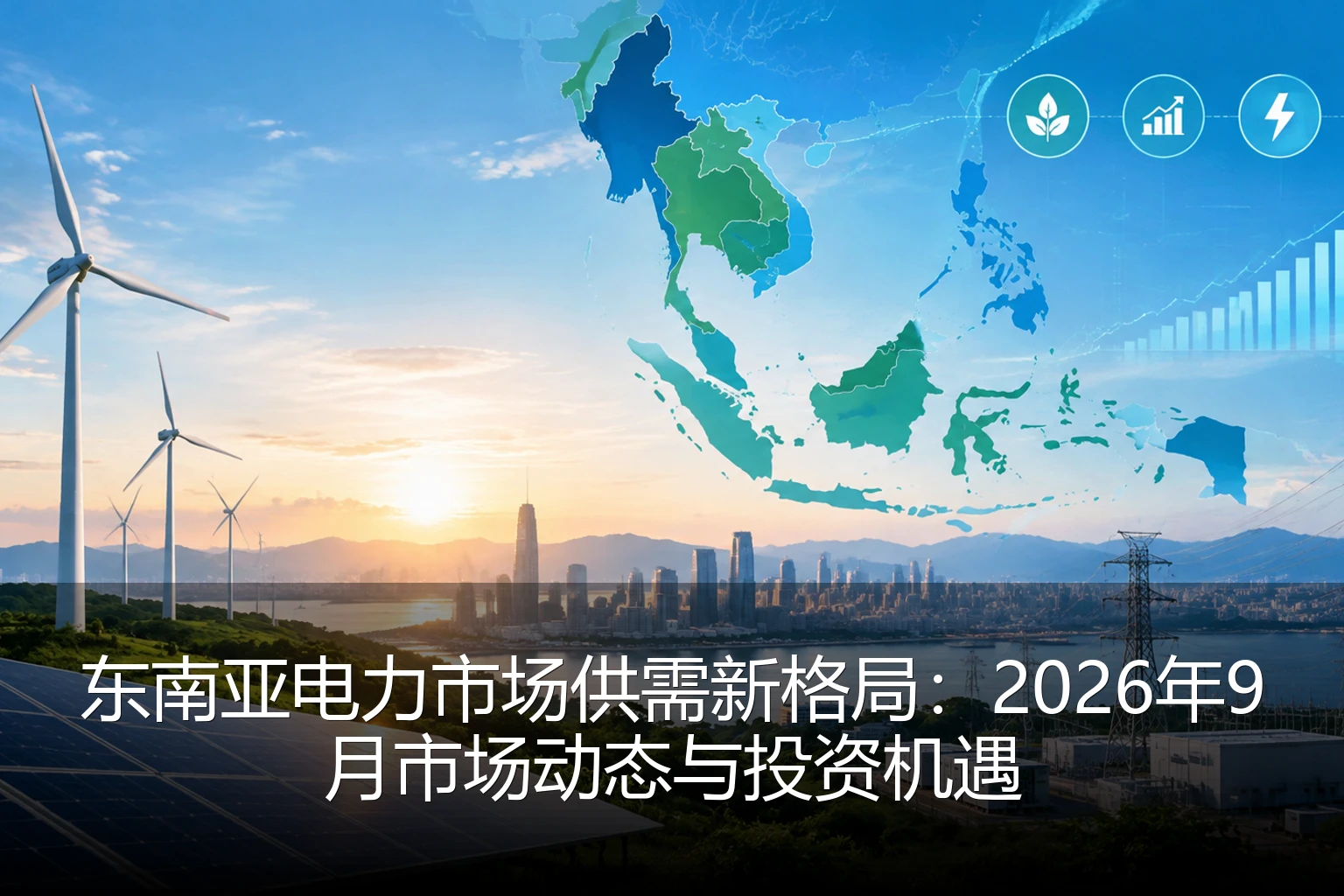
New Landscape of Power Supply and Demand in Southeast Asia: Market Dynamics and Investment Opportunities in September 2026
In September 2026, the Southeast Asian power market is at a critical juncture of profound transformation. As the regional economy continues to grow, climate change impacts intensify, and the energy transition accelerates, the power supply and demand structure across Southeast Asian nations is undergoing significant changes. This article will comprehensively analyze the current supply and demand dynamics of the Southeast Asian power market, explore the key factors influencing the market, and uncover investment opportunities and potential risks within it.
Analysis of Power Supply and Demand in Southeast Asia
According to the latest data from the ASEAN Centre for Energy (ACE), in the first half of 2026, the total power demand in the Southeast Asian region grew by 6.8% year-on-year, reaching 1.2 trillion kilowatt-hours, exceeding the global average growth rate. This growth is primarily driven by emerging industrialized nations such as Vietnam, Indonesia, and the Philippines, which exhibit robust industrial electricity consumption.
On the supply side, in September 2026, the total installed capacity in the Southeast Asian region reached approximately 350GW, with the share of renewable energy increasing to 32%, a rise of nearly 15 percentage points compared to 2020. However, the regional power supply and demand still face significant imbalances, with power shortages during the dry season being particularly acute in countries like Vietnam, Thailand, and Malaysia.
Notably, the average wholesale electricity price in Southeast Asia rose by 12% in September 2026, with some peak-hour electricity prices increasing by over 30%. This price volatility reflects the tight supply-demand situation in the regional power market, while simultaneously presenting new market opportunities for investors.
Key Factors Influencing Power Supply and Demand
Climate Change and Extreme Weather
In 2026, the Southeast Asian region experienced record high temperatures, with temperatures in several countries surpassing historical highs. Extreme heat not only drives up cooling electricity demand from air conditioning but also leads to a significant decrease in hydropower generation. Taking Vietnam as an example, hydropower generation decreased by 28% year-on-year in September 2026, forcing the country to increase natural gas and coal power generation, which further drives up electricity costs.
Concurrently, changes in precipitation patterns caused by climate change have affected the stability of regional power supply. Water levels in reservoirs of traditional hydropower giants like Thailand and Malaysia remain below historical averages, limiting hydropower generation capacity and necessitating reliance on expensive natural gas power to fill the gap.
Economic Development and Electricity Demand Growth
In 2026, the Southeast Asian economy continued to maintain steady growth, with the annual GDP growth expected to reach 4.8%. As manufacturing expansion and urbanization accelerate, regional power demand continues to climb. The rapid growth in emerging electricity consumption sectors, such as data centers and electric vehicle charging stations, places higher demands on power supply.
Vietnam, as a manufacturing hub in Southeast Asia, saw a 9.5% year-on-year increase in industrial electricity demand in 2026, becoming a major driver of regional power demand growth. At the same time, the booming digital economy in Thailand and Indonesia, with data center electricity consumption growing by over 20% annually, further exacerbates the regional power supply and demand tightness.
Energy Transition and Renewable Energy Development
Driven by carbon neutrality goals, Southeast Asian countries are accelerating their energy transition, leading to continuous growth in renewable energy installed capacity. In the first half of 2026, the Southeast Asian region added approximately 12GW of renewable energy capacity, with solar and wind power accounting for over 85% of this addition.
Singapore, as a leader in regional energy transition, launched the "Solar 2030" plan in September 2026, aiming to increase solar power capacity to 2GW by 2030, meeting 15% of urban electricity demand. This plan will not only significantly boost Singapore's renewable energy share but also drive the development of the solar industry in neighboring countries. However, the intermittent and volatile nature of renewable energy also poses challenges to grid stability. In August 2026, parts of Thailand and the Philippines experienced grid frequency fluctuations and localized power outages due to sudden drops in photovoltaic power generation, highlighting the technical challenges of large-scale renewable energy grid integration. Cross-border Power Cooperation Progress To address regional power supply and demand imbalances, Southeast Asian nations are accelerating cross-border power cooperation. In September 2026, the second phase of the Laos-Vietnam 500kV grid project officially commenced operation, increasing Laos's hydropower transmission capacity to the Guangdong-Hong Kong-Macao Greater Bay Area to 3000MW, effectively alleviating power shortages in Vietnam during the dry season. The ASEAN Power Grid initiative has also made significant progress, currently connecting the power grids of Thailand, Malaysia, Singapore, and Vietnam. According to the ASEAN Energy Centre forecast, the scale of cross-border power trading is expected to triple by 2030, significantly enhancing regional power supply stability and economic efficiency. Key National Power Market Dynamics Vietnam The Vietnamese power market underwent significant changes in 2026. Due to reduced hydropower output, Vietnam was forced to increase LNG power generation imports, with LNG imports growing by 45% in the first half of 2026. Concurrently, Vietnam is accelerating renewable energy development, planning to reach 40% renewable energy capacity by 2030. To address power supply challenges, the Vietnamese government introduced a power market reform plan in August 2026, introducing a real-time electricity pricing mechanism and allowing private enterprises to participate directly in power trading. These reforms are expected to improve power market efficiency but may also exacerbate electricity price volatility. Thailand The Thai power market in 2026 exhibited a "dual track" characteristic: on one hand, traditional fossil fuels still dominate, accounting for 65% of total power generation; on the other hand, renewable energy is developing rapidly, with continuous growth in solar and wind power capacity. The Electricity Generating Authority of Thailand (EGAT) announced a new energy development plan in September 2026, aiming to increase the share of renewable energy to 40% by 2036 while promoting smart grid construction to enhance power system flexibility. This plan is expected to attract over $50 billion in investment. Indonesia As the largest economy in Southeast Asia, the Indonesian power market is vast and growing rapidly. In 2026, Indonesian power demand increased by 7.2%, mainly driven by industrial electricity consumption growth in Java and Sumatra. The Indonesian government is actively promoting the "3500MW" renewable energy plan, aiming to add 3500MW of renewable energy capacity by 2030. Furthermore, Indonesia is accelerating geothermal energy development, with geothermal power capacity reaching 2400MW in 2026, making it the world's largest geothermal power producer. Malaysia Malaysia's power market faces transformation challenges in 2026. On one hand, the state-owned utility TNB still dominates the market, holding over 70% of the market share; on the other hand, renewable energy is developing rapidly, with solar installed capacity exceeding 1GW in the first half of 2026. The Malaysian government released a power market reform white paper in July 2026, planning to gradually open the power market and introduce competitive mechanisms. This reform is expected to improve market efficiency but may also lead to short-term electricity price fluctuations. Singapore As an urban economy, Singapore's power demand growth is relatively stable, increasing by about 3.5% year-on-year in 2026. The Singapore power market is highly dependent on natural gas generation, accounting for over 95%. To reduce carbon emissions, Singapore is actively developing solar power and importing renewable energy. In September 2026, the Energy Market Authority (EMA) of Singapore announced a new power market reform plan, which aims to introduce a "capacity market" mechanism to ensure long-term power supply stability. This reform offers new market opportunities for investors but also increases market complexity. Power Market Investment Opportunities and Risks Investment Opportunities The Southeast Asian power market offers abundant opportunities for investors. First, the renewable energy sector continues to attract significant investment. In the first half of 2026, renewable energy investment in Southeast Asia reached $28 billion, an 18% year-on-year increase. Solar, wind, and energy storage projects are hot investment areas. Second, the prospects for cross-border power infrastructure investment are vast. With the advancement of the ASEAN grid interconnection plan, there is a high demand for infrastructure such as cross-border transmission lines and substations. Projects like the Laos-Vietnam interconnection and the Thailand-Malaysia interlink have attracted international investor attention. Third, power market reforms create new opportunities. Power market reforms in countries like Vietnam and Malaysia provide new avenues for private enterprises to participate in power trading. Emerging business models such as Virtual Power Plants (VPP) and demand response are also gradually emerging in Southeast Asia. Investment Risks Despite the numerous opportunities, investment in the Southeast Asian power market still faces multiple risks. First, policy uncertainty is a major challenge. Changes in national energy policies, adjustments to subsidy policies, and electricity price mechanism reforms can all affect investment returns. Second, insufficient grid infrastructure constrains renewable energy development. Many countries' grid upgrades lag behind, making it difficult to accommodate the needs of large-scale renewable energy integration, which increases investment risk. Third, geopolitical factors affect cross-border power cooperation. Regional political tensions and energy security concerns can impact the progress of cross-border power projects. Future Outlook and Recommendations Looking ahead, the Southeast Asian power market will exhibit the following development trends: * The share of renewable energy will continue to increase, expected to reach 35%-40% by 2030. * Power market reforms will deepen, and competitive mechanisms will gradually improve. * Cross-border power cooperation will strengthen, and the degree of regional grid interconnection will increase. * Energy storage technology will develop rapidly to solve the intermittency issues of renewable energy. * Digital and intelligent technologies will be widely applied to improve grid operation efficiency. For investors, we offer the following recommendations:- Pay attention to policy direction and select investment projects aligned with national energy strategies.
- Emphasize risk management, diversify investment portfolios, and reduce single-project risk.
- Focus on technological innovation and seize opportunities from digital and intelligent transformation.
- Strengthen regional cooperation and utilize opportunities from cross-border power markets.
- Pay attention to ESG factors to ensure sustainable investment.