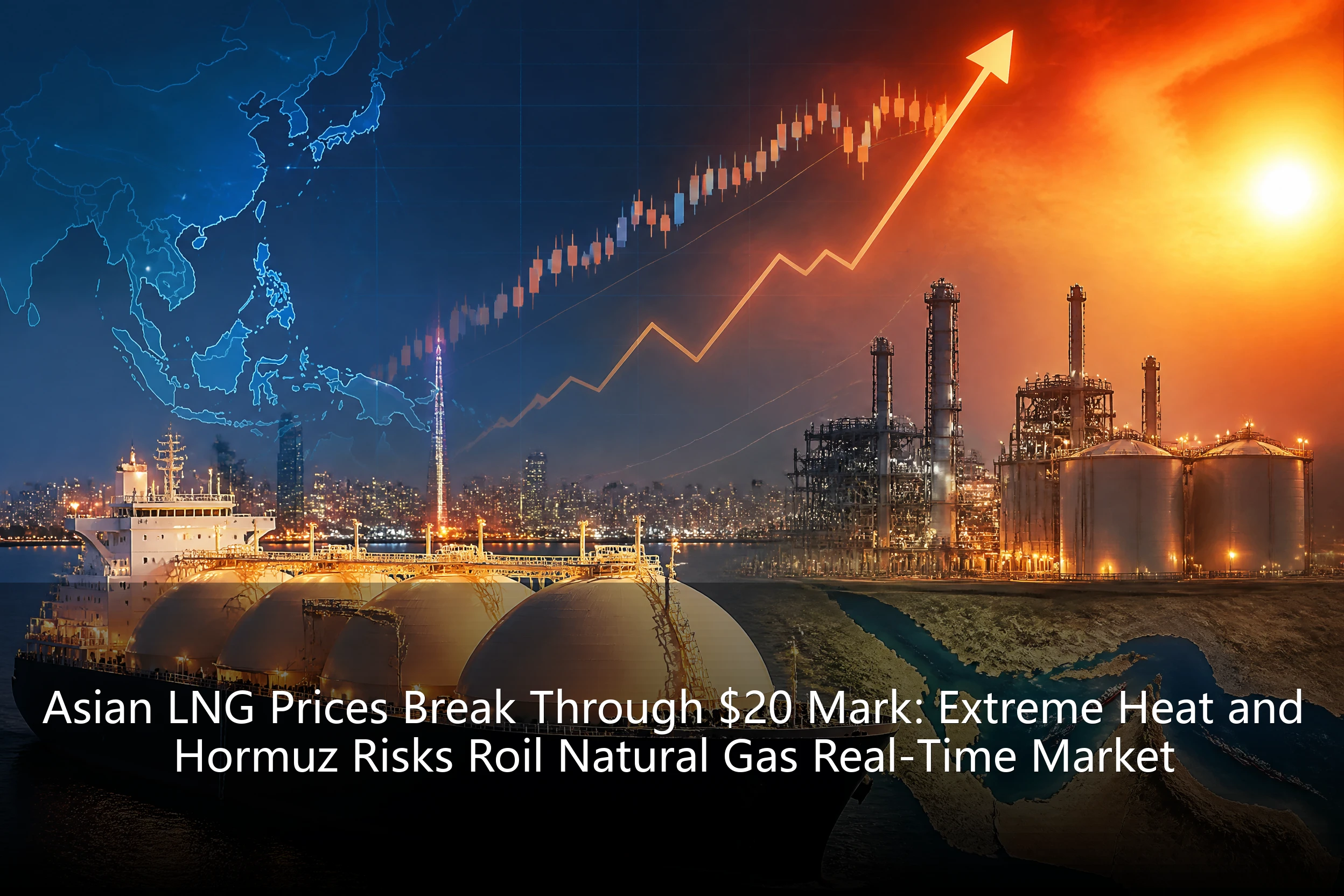
The global natural gas market is again in the spotlight. On August 3, energy consultancy Rystad Energy's latest gas and LNG market update showed that, under the dual pressure of geopolitical risks and extreme heat, East Asian LNG prices for October delivery edged up 0.4% month-on-month to $20.4 per million British thermal units (MMBtu). Meanwhile, Reuters' weekly survey of spot prices for August delivery in Northeast Asia showed the average spot price jumped from $16.4 last week to $18.0/MMBtu, a weekly surge of 9.8%, the highest in nearly a month. The three-week rally has once again made Asia's real-time natural gas market the most watched focus in global energy markets.
Market Snapshot: Spot and Futures Strengthen Together, Asian Premium Widens
From a data perspective, this rally shows a clear "all-round strength" feature. On futures, East Asian LNG for October delivery recorded $20.4/MMBtu on August 3, with limited weekly gains but holding above $20 for several weeks. On spot, the Northeast Asian August delivery average surged 9.8% week-on-week, signaling sharply heating market sentiment. Rystad Energy noted that although prices remain close to the $20 mark, buying interest has clearly expanded. Major East Asian buyers are locking in supply ahead of expected high temperatures, providing solid support for the market.
Strait of Hormuz: Geopolitical Risk Premium Returns
The primary factor driving this price jump is the renewed deterioration of geopolitical tensions in the Persian Gulf. According to multiple foreign media reports, as attacks on merchant vessels have increased again and US-Iran military operations have escalated, maritime security in the Strait of Hormuz has deteriorated sharply. The previously damaged Qatari LNG carrier "Al Rekayyat" and the subsequent US military response have led the market to reprice a substantial geopolitical risk premium.
As the world's largest LNG exporters, Qatar and the UAE rely almost entirely on the Strait of Hormuz as the sole maritime channel for their LNG exports, together supplying about one-fifth of global LNG. Any disruption to transit could trigger a supply crisis. Latest shipping data shows that since July 11, the first confirmed LNG carrier to leave the strait, "Al Areesh", transited on July 29, and the number of LNG vessels passing through the waterway has since fallen sharply again. QatarEnergy has extended its force majeure declaration until mid-October, further intensifying market concerns over fourth-quarter supply.
Over a longer time frame, since the conflict broke out in late February, the JKM index has accumulated gains of nearly 97%, with Asian gas prices rising significantly more than Brent crude. From March to June, more than 300 LNG cargoes from Qatar and about 20 from the UAE failed to enter the market as scheduled, and about 160 LNG carriers were stranded in the Persian Gulf or forced to wait at Gulf of Oman anchorages. Although new capacity from North America and Africa partially filled the gap, the IEA estimates that about a quarter of the lost supply cannot be replaced, fully exposing the fragility of global LNG supply.
Extreme Heat: East Asian Peak Demand Season Ignites Early
If geopolitical risk is the "gunpowder" for the rally, then extreme heat is the "fuse" that ignites it. Rystad Energy specifically noted in its report that the probability of above-average temperatures in Japan and South Korea in August is as high as 60%-70%, meaning East Asia faces another scorching summer. High temperatures directly boost air-conditioning electricity demand, prompting power plants to increase gas-fired generation, thereby driving up LNG purchase intentions.
In China, buyers are actively replenishing inventories to cope with peak summer electricity demand. Customs and industry data show that Asian LNG imports rebounded notably in July, with China's purchases growing particularly strongly, reversing the weak trend since the second quarter. However, the upward price momentum is also somewhat contained: Japan has relatively high inventories, South Korea remains cautious in the spot market, and most Asian buyers have already locked in most of their August-September demand, easing short-term competition for European cargoes. But if high temperatures persist beyond expectations, a new round of restocking could push prices even higher at any time.
Freight and Insurance Costs: The "Hidden Price Increase" in the Gas Supply Chain
Besides the cargo price itself, transportation and insurance costs in the LNG supply chain are also soaring, creating "hidden price increase" pressure. According to the July market report of the Gas Exporting Countries Forum (GECF), after the transit disruption in the Strait of Hormuz, available LNG carrier capacity tightened sharply. In early March, daily charter rates for tri-fuel diesel-electric (TFDE) LNG carriers surged to as high as $235,000, the highest since the 2022 energy crisis; marine fuel prices jumped 73% month-on-month in March, exceeding $800 per ton. The war risk insurance premium for a single transit of the Strait of Hormuz for an LNG carrier worth $250 million reached as much as $25 million.
Detouring via the Cape of Good Hope has become a reluctant choice, but this route adds 15-20 extra days to the voyage between the Atlantic and Asia-Pacific, significantly raising transport costs. Data shows that the transport cost of US LNG to Northeast Asia via the Cape has doubled from $1.8/MMBtu in the same period last year to $3.6/MMBtu; the average cost via the Panama Canal route is about $2.8/MMBtu in Q2 2026. Currently, LNG carrier daily charter rates in the Atlantic Basin have risen to $97,500, while in the Pacific they are $70,250. Freight's share of total delivery costs has climbed from 13% to about 25%. For ASEAN buyers, this means that even excluding geopolitical premiums, landing costs have been greatly pushed up by supply chain frictions.
ASEAN Perspective: Rethinking Energy Security Under Import Pressure
For ASEAN countries, the impact of this LNG rally should not be underestimated. Economies such as Thailand, Vietnam, the Philippines and Singapore have increasingly relied on LNG imports, while traditional exporters like Malaysia and Indonesia are also stepping up domestic gas power development. In Vietnam, bottled LPG prices were raised again in August, with world LPG import contract prices rising to $630 per ton, and retail prices remaining high—LPG prices are linked to LNG and directly pass through to household costs. For many Southeast Asian countries promoting coal-to-gas switching and gas power peaking, high import prices are testing the fiscal affordability of their energy transitions.
On the positive side, high gas prices are also forcing ASEAN to accelerate energy diversification. The importance of renewable energy installations, cross-border power trading and domestic natural gas development is being reassessed, with energy security and cost control becoming core keywords in regional energy policy. For investors, gas companies with long-term contract price-locking capabilities, developers with local resource endowments, and renewable energy assets benefiting from accelerated energy transition may all gain structural opportunities in this volatility.
Outlook: $25 Is Not a Pipe Dream
Looking ahead, market divergence is widening. Morgan Stanley previously predicted that Asian LNG prices could rise further to $25/MMBtu in Q3-Q4 2026, with the forward curve implying gains of more than 30%. Consulting firm Gas Strategies warned that if Gulf exports remain below capacity, global LNG demand could shrink by about 8% in 2025-2026—if realized, this would mark the first annual negative growth in global LNG trade in over a decade, with risks on both supply and demand sides rising simultaneously throughout the year.
Energy majors such as Shell also note that LNG export facilities still need 6-8 weeks to restart after shipping resumes, and the summer restart window is closing. It is foreseeable that volatility in the Asian natural gas market will remain high until the situation in the Strait of Hormuz becomes clear. For traders, real-time tracking of JKM prices, shipping movements and inventory data is key to grasping market rhythm; for industry and investors, locking in long-term contracts, diversifying portfolios and hedging risks are essential lessons to protect cost baselines in an era of high volatility.
The storm is still brewing. Every tick of the real-time natural gas market reminds us: under the dual variables of geopolitics and climate change, energy security has never been so expensive, and never so important.