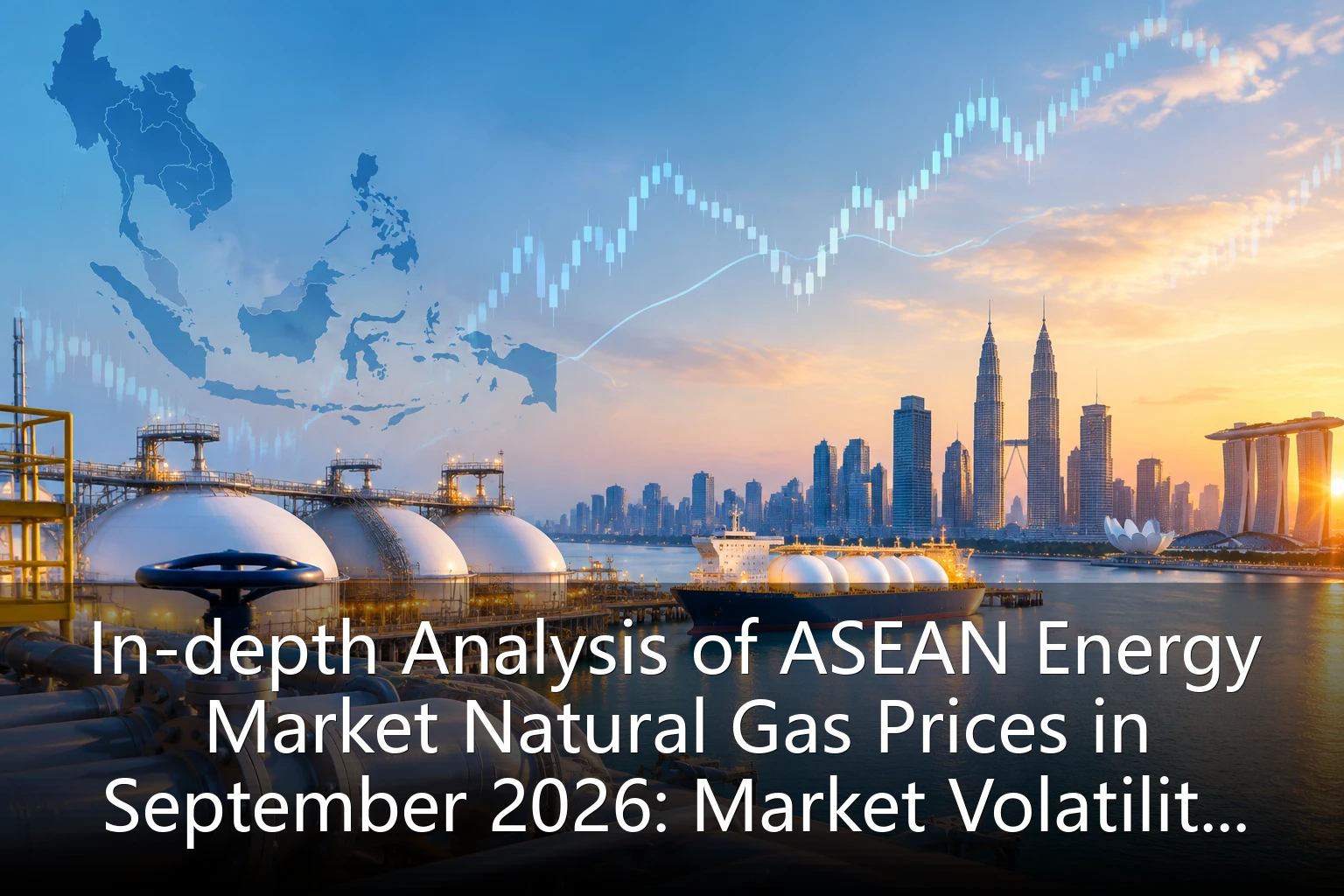
In-depth Analysis of ASEAN Energy Market Natural Gas Prices in September 2026: Market Volatility and New Investment Opportunities
\n\nIn September 2026, the natural gas prices in the ASEAN energy market experienced significant fluctuations, bringing new opportunities and challenges to investors. As an important component of the global energy landscape, the dynamics of the ASEAN region's natural gas market not only affect regional economic development but also have a profound impact on the global energy supply-demand balance. This article will comprehensively analyze the current price trends, influencing factors, and future investment prospects of the natural gas market, providing investors with professional and in-depth market insights.
\n\nMarket Dynamics: Intensified Price Volatility and Reshaped Supply-Demand Structure
\n\nIn September 2026, the natural gas prices in the ASEAN energy market showed clear volatility characteristics. According to the latest market data, the spot price of liquefied natural gas (LNG) reached a high of $18.5 per million British thermal units (MMBtu) in early September, then fell to $16.2 in mid-month, and rebounded to $17.8 by month-end, with an overall fluctuation range exceeding 13%. This increased volatility compared to previous months reflects rapid changes in market supply-demand relationships.
\n\nFrom a regional perspective, the market performance of major ASEAN natural gas consuming countries such as Singapore, Thailand, and Malaysia varied. Singapore, due to its high dependence on imported LNG, experienced more severe price fluctuations; while Indonesia and Malaysia, as major producers, maintained relatively stable domestic prices, but their export prices fluctuated in sync with the international market. Vietnam, as an emerging natural gas consumer, saw its price trend generally consistent with the regional average, but its price elasticity increased due to growing domestic electricity demand.
\n\nAnalysis of Influencing Factors: Multiple Interacting Factors
\n\nChanges in Supply-Demand Relationship
\n\nThe supply-demand relationship is the core factor affecting natural gas prices. In September 2026, the ASEAN region's natural gas supply faced multiple challenges. On one hand, production growth in traditional producer countries like Indonesia and Malaysia slowed, with new development projects delayed; on the other hand, the LNG export capacity of Australia and the United States continued to increase, supplementing the regional market. In terms of demand, as summer ended, power generation and cooling demand decreased, but industrial gas consumption maintained steady growth, especially in the chemical and manufacturing sectors.
\n\nSeasonal Factors and Climate Impact
\n\nSeasonal factors played an important role in September's natural gas price fluctuations. As the Northern Hemisphere summer ended, air conditioning and cooling demand decreased, but power generation and industrial demand remained strong. Meanwhile, the increase in extreme weather events due to climate change, such as typhoons and heavy rains, caused short-term disruptions to natural gas production and transportation, exacerbating market volatility. In early September 2026, Typhoon "Haiyan" struck southern the Philippines, affecting the operation of local natural gas facilities and causing short-term supply shortages.
\n\nGeopolitical Factors
\n\nGeopolitical factors continue to have a profound impact on the ASEAN energy market. The Strait of Hormuz, as one of the world's most important energy transportation channels, its security situation directly affects natural gas supply. In September 2026, the situation in the region was relatively stable, but market concerns about potential conflicts persisted, keeping prices high. Additionally, international political factors such as China-US relations and the Russia-Ukraine conflict indirectly affected the price trends of the ASEAN energy market.
\n\nImpact of Energy Transition Policies
\n\nAs the global energy transition accelerates, policy adjustments by various countries have increasingly significant impacts on the natural gas market. In September 2026, multiple ASEAN countries released new energy development plans, emphasizing the role of natural gas as a "bridge fuel" in the energy transition. Indonesia announced plans to expand LNG exports while increasing the proportion of domestic natural gas usage; Vietnam adjusted its power development plan, raising the share of natural gas in its energy structure. These policy changes provide long-term support for the natural gas market but also increase short-term uncertainty.
\n\nRegional Analysis: Diverse Market Characteristics Across ASEAN Countries
\n\nIndonesia: Traditional Producer Faces Transition Challenges
\n\nAs the largest natural gas producer in ASEAN, Indonesia faced challenges of slowing production growth in September 2026. The contradiction between rising domestic consumption demand and export policy adjustments has become increasingly prominent. The Indonesian government plans to balance supply and demand by increasing domestic natural gas prices, but this policy may affect the competitiveness of downstream industries. Meanwhile, Indonesia is actively developing new gas fields, but project delays make it difficult to bridge the production gap in the short term.
\n\nMalaysia: Stable Supply and Price Control
\n\nIn September 2026, Malaysia maintained relatively stable natural gas supply and price levels. As the second-largest natural gas producer in ASEAN, Malaysia effectively controlled domestic price fluctuations through long-term contracts and government intervention. However, with growing domestic demand and increasing export pressure, the Malaysian government faces the challenge of balancing domestic supply with export revenue. In the future, Malaysia may adjust its natural gas pricing mechanism to better reflect market changes.
\n\nSingapore: Highly Import-Dependent Market
\n\nSingapore, as an important energy hub and trading center in ASEAN, has a natural gas market highly dependent on imports. In September 2026, Singapore's LNG spot price fluctuations exceeded the regional average, reflecting changes in the international market. The Singapore government has enhanced energy security through diversified import sources and strategic reserves, but price fluctuations still have a significant impact on the economy. As Singapore advances its energy transition, the proportion of natural gas in its power generation structure will gradually decrease, but it will maintain an important position in the short term.
\n\nVietnam: Opportunities and Challenges of an Emerging Consumer Market
\n\nAs an emerging natural gas consumer in ASEAN, Vietnam experienced rapid price increases in September 2026. With growing domestic electricity demand and coal-fired power emission reduction policies, Vietnam's natural gas consumption has continued to rise. However, Vietnam's natural gas infrastructure is relatively weak, with high import dependence, making price fluctuations significantly impact the economy. The Vietnamese government is actively developing domestic natural gas resources and seeking regional cooperation mechanisms with neighboring countries to enhance energy security.
\n\nInvestment Strategies: Seizing Opportunities in Market Volatility
\n\nLong-term Investment Value
\n\nDespite intensified short-term price fluctuations, natural gas's position as a "bridge fuel" in the ASEAN energy transition provides long-term investment value. Investors can focus on production companies with stable resource reserves and long-term contracts, as well as companies benefiting from regional natural gas infrastructure development. Especially in resource-rich countries like Indonesia and Malaysia, natural gas development projects still have considerable investment return potential.
\n\nShort-term Trading Opportunities
\n\nFor short-term investors, seizing trading opportunities in price fluctuations is crucial. Market data from September 2026 shows a significant spread between natural gas futures and spot prices, providing space for arbitrage trading. Meanwhile, short-term price fluctuations caused by seasonal factors and climate events also create opportunities for intraday trading. However, short-term trading carries higher risks, and investors need to establish strict risk control mechanisms.
\n\nRegional Cooperation and Infrastructure Development
\n\nASEAN regional natural gas cooperation and infrastructure development provide unique investment opportunities. In September 2026, the ASEAN Gas Interconnection Pipeline project made new progress, with continuously improving regional connectivity. Investors can focus on projects participating in cross-border natural gas pipeline construction, LNG terminal operations, and regional trading center development. Although these projects have long investment cycles, they offer stable cash flows and long-term returns.
\n\nEnergy Transition Related Investments
\n\nWith the acceleration of energy transition, low-carbon technology investment opportunities related to natural gas are increasingly prominent. In September 2026, several international energy giants announced investments in carbon capture and storage (CCS) technology in the ASEAN region, as well as renewable energy and natural gas hybrid power projects. Such investments not only align with global emission reduction trends but also provide stable returns for investors. Especially for companies with advantages in natural gas infrastructure, the low-carbon transition provides new growth points.
\n\nFuture Outlook: Market Structure Evolution and Investment Prospects
\n\nLooking ahead, natural gas prices in the ASEAN energy market are expected to continue showing volatile characteristics, but long-term trends will be influenced by multiple factors. On one hand, as the global energy transition progresses, the proportion of natural gas in the energy structure will gradually adjust; on the other hand, regional economic growth and industrialization will continue to support natural gas demand. By 2030, ASEAN natural gas consumption is expected to grow by about 30%, but the growth rate will gradually slow down.
\n\nFrom an investment perspective, natural gas investment in the ASEAN energy market will show a diversified trend. Traditional upstream development projects will still occupy an important position, but investment opportunities in downstream processing, trading, and infrastructure development will grow rapidly. Meanwhile, with the improvement of carbon pricing mechanisms, low-carbon natural gas technologies will become investment hotspots. Investors need to closely monitor policy changes, technological advancements, and market dynamics, flexibly adjusting investment strategies.
\n\nOverall, the natural gas price fluctuations in the ASEAN energy market in September 2026 reflect deep-seated changes in market structure. For investors, grasping this trend, focusing on short-term market opportunities while looking at long-term investment value, will be key to achieving excess returns. Against the backdrop of energy transition, the position of natural gas as a "bridge fuel" is difficult to replace in the short term, but its market structure and investment logic are undergoing profound changes, requiring investors to maintain keen market insight and flexible investment strategies.