Hong Kong’s Semiconductor Sector Rallies Against Market Headwinds: Stacked Bullish Catalysts and Accelerated Domestic Substitution Unlock a New Industry Landscape
Introduction
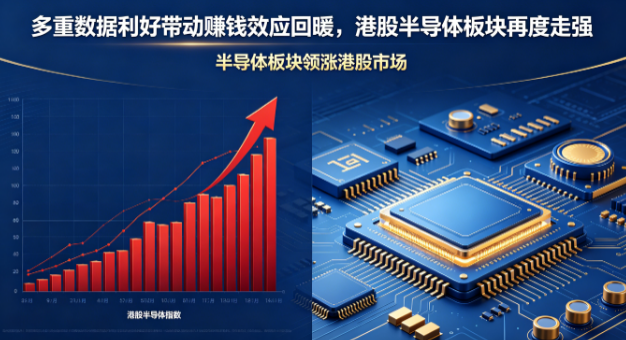
Amid heightened volatility across global markets, Hong Kong-listed semiconductor stocks have staged a strong counter-trend rally recently with standout performance. As of press time, newly listed SENASIC (06675.HK) surged more than 120%; Lanner Technology (06809.HK) rose over 9%; Hua Hong Semiconductor (01347.HK) gained above 6%; while InnoScience (02577.HK) and other peers climbed more than 3%. This powerful rally is no coincidence, driven by a confluence of positive catalysts: record-high global semiconductor equipment shipments, an explosion in memory chip demand, surging Korean export figures, upgraded industry ratings from institutional investors, and an upcoming price hike cycle for domestic AI chips. All signals point to sustained prosperity and structural transformation within the semiconductor industrial chain. This article thoroughly dissects the logic behind the current rally from multiple dimensions and explores future industry trends.
Record Global Semiconductor Equipment Shipments: Definite Growth Fueled by AI Investment
A latest report by SEMI revealed that global semiconductor equipment shipments reached US$36.55 billion in Q1 2026, up 14% year-on-year and 1% quarter-on-quarter, hitting an all-time quarterly high. The data not only confirms enduring prosperity across the semiconductor supply chain but also underscores the robust traction brought by AI-related capital expenditure.
Structurally, shipment growth is concentrated in advanced process and memory chip segments. The explosive demand for training and inference of large AI models has triggered a sharp uptick in demand for high-performance computing chips including GPUs and HBM, directly boosting procurement of high-end semiconductor gear such as advanced lithography systems, etching equipment, and thin-film deposition tools. SEMI’s statistics show this momentum accelerated further rather than slowing in Q1 2026.
Notably, alongside record shipment values, lead times for semiconductor equipment remain prolonged, with delivery schedules for certain high-end tools stretched to 12–18 months. This indirectly indicates the supply-demand imbalance will persist in the short term, sustaining robust prosperity for upstream supply chain players. For Hong Kong-listed semiconductor equipment stocks, this translates to clear order visibility and solid earnings support.
Memory Chips: Core Engine Driving the Global Semiconductor Market Upturn
Data from Omdia further lays bare structural shifts across the semiconductor industry: the global semiconductor market saw a notable jump in Q1 2026, with memory chips acting as the primary growth driver. Memory chip revenue jumped sharply in Q1 2026, lifting overall global semiconductor revenue out of its previous plateau and pushing up aggregate quarterly growth substantially.
The memory chip boom stems from three key factors. First, AI servers generate exponentially rising demand for HBM (High-Bandwidth Memory). Mainstream AI chips now require HBM3 or HBM3E integration, yet capacity expansion for these products far lags demand growth. Second, data center procurement of high-capacity DRAM and NAND Flash keeps rising, as AI inference requires massive temporary data storage and read-write capacity. Third, while consumer electronics recover sluggishly, flagship smartphones are universally equipped with 16GB DRAM, forming a floor for memory chip demand.
Korean export statistics corroborate this trend: in the first 10 days of June, Korea’s total exports soared 85.9% year-on-year, with semiconductor exports jumping 205.8% versus a prior reading of 149.8%. As the world’s major memory chip manufacturer, Korea’s export surge directly reflects widening supply-demand gaps for memory products. Research by Huachuang Securities notes the current semiconductor upcycle is still in an accelerated expansion phase, not nearing its end.
Accelerated Domestic Substitution: Medium-to-Long-Term Growth Driven by Policies and Market Forces
In its recently released 2026 H2 tech industry outlook, BOCOM International projected AI themes will continue dominating market sentiment in the second half of the year. The institution upgraded its rating for A-share and Hong Kong-listed semiconductor manufacturing and diversified component stocks to Overweight, stating faster chip domestic substitution will unlock incremental medium-to-long-term growth space.
This view rests on solid industrial fundamentals. Amid persistent geopolitical uncertainties, domestic semiconductor replacement in China has shifted from an optional strategy to an industrial necessity. Massive capital investment is required both for capacity expansion in mature processes and breakthroughs in advanced nodes. Hong Kong-listed semiconductor firms including Hua Hong Semiconductor and Lanner Technology stand to benefit from this trend. Hua Hong Semiconductor focuses on specialty process wafer fabrication, holding leading positions in power devices and analog chips; Lanner Technology commands significant market share in niche tracks such as memory interface chips and PCIe Retimers.
Furthermore, Korea’s imports from China rose 57.4% year-on-year (versus the prior 28.8%). This statistic signals a shifting role for China within the global semiconductor supply chain. On one hand, as the world’s largest consumer electronics market, China maintains strong chip demand. On the other, rising domestic semiconductor manufacturing capacity fuels fast-growing demand for upstream materials, equipment, and design services. This two-way interaction creates vast growth potential for Hong Kong-listed semiconductor chain participants.
Domestic AI Chips: Upcoming Price Hike Cycle Amid Supply-Demand Imbalances
Analysis by Huatai Securities states accelerated development of multimodal large models and AI Agents has driven skyrocketing domestic Token consumption, rapidly lifting computing power demand for inference workloads. Wide gaps between domestic computing supply and demand will persist through 2025–2027. Driven by surging upstream costs and tight domestic computing capacity, domestic AI chips are poised to enter a price hike cycle.
This conclusion is backed by multiple layers of evidence. On the demand side, major Chinese internet platforms including ByteDance, Alibaba, Baidu and Tencent have launched proprietary large AI models and actively rolled out commercial applications. Explosive Token usage has drastically expanded demand for domestic AI chips such as Huawei Ascend and Hygon Information products. On the supply side, advanced process capacity remains constrained, while reliance on imported core IP (such as high-bandwidth memory interfaces) keeps production costs elevated. Against this supply-demand mismatch, price increases are virtually inevitable.
For Hong Kong’s semiconductor sector, this implies listed players may deliver stronger profit elasticity than market expectations. Enterprises occupying critical links in the AI chip supply chain—such as firms offering packaging, testing or key component services for AI chips—will reap rewards from the price upcycle.
Global Semiconductor Cycle Outlook: Confirmation of an Accelerated Expansion Phase
Aggregated industry data confirms the global semiconductor cycle is currently in an accelerated boom stage. Historically, semiconductor cycles last 3–4 years with upward phases spanning roughly 1.5–2 years. The current cycle launched in late 2023 and has run for approximately one year; yet core indicators including Korean export growth, semiconductor equipment shipment values and memory chip revenue show growth is accelerating rather than decelerating.
Another noteworthy structural shift is the rising proportion of AI-driven demand. Traditional semiconductor upswings were led by PCs and smartphones, whereas this cycle draws its primary incremental growth from emerging segments: AI servers, data centers and edge AI. This means the semiconductor market can sustain strong prosperity even if consumer electronics recovery falls short of forecasts.
For investors, valuations across Hong Kong’s semiconductor sector sit around historical averages with no obvious asset bubble. Upward earnings revisions and improved market liquidity will support further share price gains. Nevertheless, investors must monitor uncertainties including geopolitical tensions and shifts in U.S. export control policies.
Conclusion
The counter-trend strength of Hong Kong’s semiconductor sector today is not an isolated market anomaly, but the combined effect of multiple structural bullish factors across the global semiconductor industry. From SEMI’s record equipment shipments and Omdia’s booming memory chip market, to surging Korean exports, faster domestic substitution, and the upcoming price hike window for domestic AI chips, every indicator points to one unified conclusion: the semiconductor upcycle is accelerating, with a longer duration and stronger momentum than historical precedents.
Within Hong Kong’s equity market, the semiconductor sector combines robust growth prospects and clear visibility. Stocks directly exposed to AI computing demand, domestic substitution and memory chip prosperity merit sustained attention. That said, investors should maintain rationality: while capturing structural opportunities, closely track industry supply-demand shifts and policy movements to secure stable long-term returns.