Strategic Position and Future Outlook of the Semiconductor Industry: Global Changes Driven by Technology
Introduction
Semiconductors, as the "heart" of the modern electronics industry, have long penetrated every corner of human life. From smartphones and AI computing to autonomous driving, IoT, and 5G communications, semiconductor chips are everywhere. In recent years, the global semiconductor industry has experienced an unprecedented business cycle, with issues such as supply chain restructuring, geopolitical struggles, and technological breakthroughs intertwined, elevating its strategic value to the level of national security. This article will deeply analyze the development direction of the semiconductor industry from three dimensions: industry status, technology trends, and market momentum, and explore its profound impact on the global economy.
1. Global Semiconductor Industry Landscape: From Division of Labor to Competition
For a long time, the semiconductor industry has exhibited a highly specialized division of labor: the United States dominates design and equipment, Taiwan and South Korea are responsible for advanced manufacturing, Europe focuses on automotive and industrial chips, and Japan holds an important position in materials and equipment. However, with the escalation of the US-China technology war, countries have realized the importance of chip self-sufficiency and have introduced massive subsidy policies to build localized semiconductor supply chains.
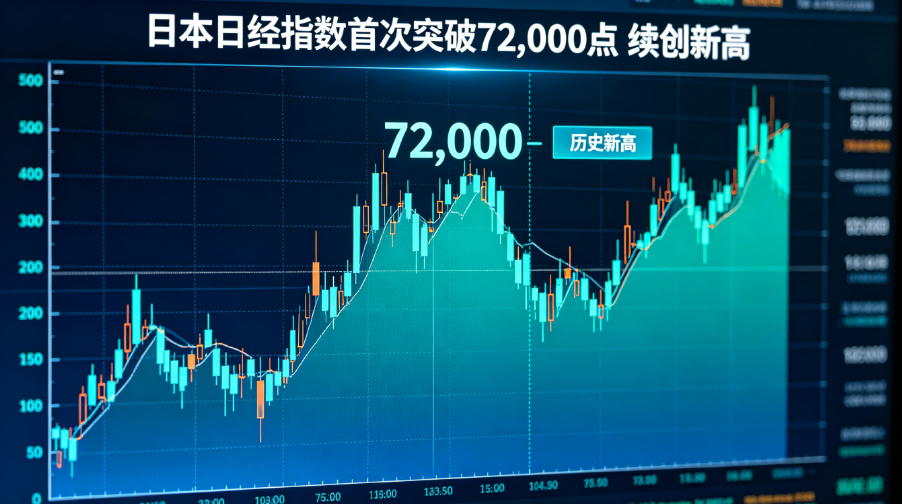
The strategic position of the semiconductor industry is also directly reflected in the capital market. For example, semiconductor-related stocks in the Japanese stock market have performed strongly, driving the Nikkei 225 index to record highs. As shown in the figure below, the Nikkei 225 index broke through 72,000 points, setting a historical record, with semiconductor equipment and materials manufacturers contributing significantly.
2. Technology Evolution: Continuation and Transcendence of Moore's Law
The core driving force of semiconductor technology comes from the miniaturization of transistor dimensions, i.e., the practice of Moore's Law. Currently, the most advanced logic processes have reached 3nm mass production, and 2nm processes are expected to be launched around 2025. However, as physical limits approach, relying solely on miniaturization is no longer sufficient to meet the dual demands of performance and power consumption. The industry is turning to system-level innovation, including advanced packaging (such as Chiplet technology), new materials (such as gallium nitride and silicon carbide), and heterogeneous integration.
In the memory field, HBM (High Bandwidth Memory) has experienced explosive growth driven by AI computing demands, becoming a standard feature for next-generation data centers and AI accelerators. In addition, NAND flash memory is moving toward 3D stacking of more than 300 layers, further increasing storage density.
3. Market Momentum: Dual Engines of AI and Electric Vehicles
The future growth of the semiconductor market mainly comes from two major areas: artificial intelligence (AI) and electric vehicles (EV). The GPUs, ASICs, and HBM memory required for AI servers are not only high-priced but also in strong demand, keeping advanced process capacity tight. Revenue and stock prices of leading companies like NVIDIA have repeatedly set records, further confirming the profitability of AI chips.
Electric vehicles are driving a surge in automotive semiconductor usage. A traditional fuel car requires about 500 chips, while a typical electric vehicle uses more than 2,000 chips, with higher specifications for power semiconductors (such as IGBT and SiC MOSFET). Silicon carbide (SiC) power components, due to their high voltage tolerance and low loss characteristics, are gradually replacing traditional silicon-based components, becoming the preferred choice for electric vehicle inverters.
4. Supply Chain Restructuring: Localization and Geopolitical Risks
Over the past two years, the global semiconductor supply chain has faced severe tests. The supply-demand imbalance caused by the pandemic, chip shortages, coupled with the US-China technology decoupling and export controls, have prompted major economies to accelerate localized production. The United States passed the CHIPS and Science Act, providing $52 billion in subsidies to attract TSMC, Samsung, and others to build factories in the US; the EU launched the European Chips Act with a target of increasing global market share to 20% by 2030; Japan has restarted its semiconductor national team, partnering with TSMC to establish advanced packaging and automotive chip production lines in Kumamoto.
However, localized production means higher costs and longer construction cycles, making it difficult to fully replace existing Asian supply chains in the short term. In addition, geopolitical uncertainties still pose risks to the industry. For example, a potential conflict in the Taiwan Strait could disrupt global chip supply. Therefore, companies are adopting multi-source supply strategies and diversifying capacity layouts to reduce dependence on a single region.
5. Future Challenges and Opportunities
Looking ahead, the semiconductor industry will face several major challenges: first, talent shortage—advanced process R&D and manufacturing require top-tier talent in physics, chemistry, and materials science, and countries have engaged in a talent war; second, energy consumption—the electricity usage of data centers and AI computing is rapidly rising, making green semiconductor manufacturing an important issue; third, technical bottlenecks—nodes beyond 2nm (such as 1.4nm, 1nm) require EUV lithography and atomic layer deposition technologies that still need substantial R&D investment.
At the same time, opportunities are equally vast. Emerging technologies such as biochips, quantum computing, and photonic chips are in their infancy. Breaking through these areas first will create entirely new growth curves for the semiconductor industry. Furthermore, with the development of 6G communications, the metaverse, and space technology, the demand for high-performance, low-power chips will only increase.
Conclusion
Semiconductors are not just a high-tech product but the infrastructure of the 21st-century digital economy. From technological progress to market expansion, from supply chain restructuring to geopolitical struggles, every aspect affects the global economic nerve. For governments and industries, only by continuously increasing R&D investment, cultivating talent, and building more resilient supply chains can they remain invincible in this "chip-centric" era. In the next decade, the competitive landscape of the semiconductor industry will become more intense, but it is also full of infinite possibilities. Whoever masters the next-generation chip technology will hold the initiative in the next wave of global economic growth.