
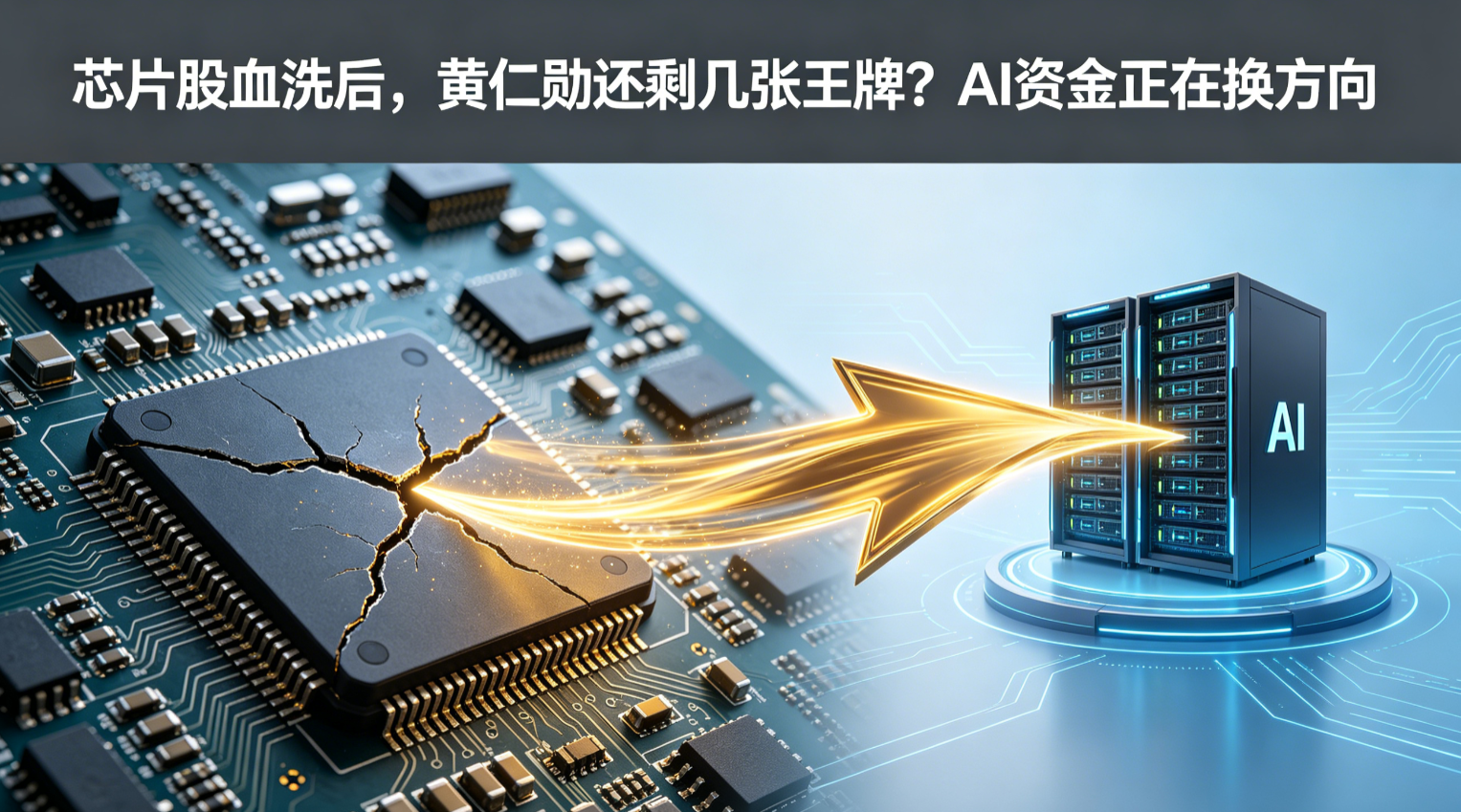
After the Mass Selloff in Chip Stocks, What Aces Does Jensen Huang Still Hold? AI Capital Is Shifting Its Flow
Is the AI rally about to collapse? NVIDIA plunged, so did Micron Technology, AMD and Marvell Technology. The entire semiconductor sector suddenly hit the brakes on Wall Street. Just a day earlier, investors were buzzing about AI computing power, data centers and GPU shortages, yet the next trading session brought a sea of red on trading screens, with portfolio swings more heart-stopping than stock price moves themselves. Frankly, the market plunge jolted investors awake before they even finished their morning coffee.
The truly alarming part of this slump is not how sharply individual chip stocks fell, but Wall Street’s repricing of the once most crowded, profitable AI trade that once lured hordes of retail investors.
Here’s the critical question: If the AI bull run is truly over, why did Jensen Huang single out Marvell Technology in public remarks at this juncture? Why is he no longer just hyping NVIDIA’s GPUs, but increasingly highlighting networking, interconnections, AI Factories and end-to-end data center infrastructure?
In today’s analysis, we will not only cover the scale of NVIDIA’s drop, or which among Micron Technology, AMD, Marvell Technology and Broadcom suffered the steepest losses. The core takeaway to grasp is this: following the brutal rout across chip stocks, does Jensen Huang still hold winning cards? More importantly, is he signaling that AI capital will gradually divert away from the overcrowded GPU segment toward new growth areas?
While investors are dumping chip stocks, looking deeper reveals Wall Street is not writing off AI entirely—it is reshuffling the pecking order within the entire AI industrial chain. Previously, any firm remotely tied to AI commanded lofty valuations. Now, only companies with tangible order books, steady profit margins and solutions easing data center bottlenecks retain a seat at the table.
Let us first clarify exactly what this massive selloff has washed out.
Over the past year, the market’s logic for buying AI stocks was simplistic, even crude. Any business linked to AI, with ties to NVIDIA, or narratives centered on data centers, computing power, servers and GPUs attracted sky-high valuations. Stock gains were driven less by actual earnings growth and more by how compelling a company’s AI growth story sounded.
The landscape has shifted dramatically; Wall Street is now demanding tangible financial results.
Where investors once asked merely “Does this company have AI exposure?”, they now pose far tougher questions: Can its AI-related revenue materialize as projected? Will profits deliver as promised? Will enterprise clients sustain heavy spending? Can cloud vendors maintain robust capital expenditure budgets? Have stock valuations already priced in years of future growth in advance?
This is the core driver of the downturn. The selloff does not negate underlying AI demand—it eliminates blind market optimism toward all AI-related assets. In other words, the broader AI investment theme remains intact, yet the era of blindly buying any stock labeled “AI” is likely finished for good.
If you hold AI supply chain stocks including NVIDIA, AMD, Micron Technology and Marvell Technology, this shift demands close attention. Instead of just checking whether a firm operates in AI, investors must assess its precise position in the industrial chain: Does it generate genuine orders or merely speculative growth narratives? Can it consistently deliver profits, or has its valuation inflated far ahead of fundamentals?
If this breakdown proves insightful, hit the like button, save this piece and subscribe to Frost & Snow Finance. We will repeatedly apply this analytical framework to evaluate AI stocks, chipmakers and the data center supply chain in future coverage—preventing investors from overindulging in rallies or spiraling into despair during pullbacks.
Why Even NVIDIA Took a Hit
Many investors may wonder: NVIDIA is the undisputed AI leader, and Jensen Huang repeatedly emphasizes robust AI demand—so why is its stock sliding? A key distinction must be drawn: a share price decline does not equate to a sudden deterioration in corporate fundamentals. Even when a business remains fundamentally strong, markets may drive its stock lower if it has surged too rapidly, carries excessive valuations and overinflated growth expectations, forcing a reality check on whether it can consistently beat forecasts.
1. Extreme Crowding in the AI Trade
Capital flooded into a narrow group of stocks for months. NVIDIA, Broadcom, Micron Technology, Marvell Technology and AMD were lumped into one monolithic AI basket. During rallies, investors piled into these names en masse, convinced they held exposure to the future. When sentiment reversed, however, this overcrowded positioning triggered a stampede to exit.
Stocks did not drop based on weak fundamentals alone; the steepest losses hit assets with the largest run-ups, heaviest institutional positioning and highest embedded growth expectations.
2. Renewed Interest Rate Headwinds
This factor weighs heavily on tech valuations. Most AI stocks are priced on multi-year future growth rather than near-term quarterly earnings. If markets fear the Federal Reserve will delay rate cuts or even resume hikes, richly valued tech names bear the brunt first.
The logic is straightforward: higher interest rates reduce the present value of future cash flows. When investors price a decade-long growth narrative against elevated discount rates, stock valuations naturally contract.
3. Markets Require Hard Evidence Beyond Generic “Strong AI Demand” Claims
Previously, investors would cheer any corporate mention of booming AI demand. Today, they demand concrete metrics: Are AI orders consistently exceeding guidance? Are gross margins eroded by rising supply chain costs? Will enterprise clients expand their spending budgets? Can firms clearly outline the return cycle for massive data center capital outlays?
NVIDIA’s selloff does not signal fading corporate strength; it reflects far stricter market scrutiny. Where investors once only confirmed NVIDIA’s status as an AI leader, they now question whether its lofty valuation can be justified by sustained outperformance. This marks a fundamental shift in market sentiment.
Jensen Huang’s Three Trump Cards
Ace One: AI Factories – A Comprehensive Integrated System, Not Just Standalone GPUs
Most investors assume NVIDIA’s core strength lies in GPU hardware sales, yet Jensen Huang’s true strategic push centers on end-to-end AI Factories.
An AI Factory can be framed as next-generation data center infrastructure. Traditional data centers function primarily as warehouses for data storage, basic processing and cloud computing workloads. AI-era data centers evolve beyond storage hubs to operate as hyper-scale production lines. Power input powers chip operation; data circulates continuously; large models undergo training; software orchestrates workflows; and intelligent services are produced nonstop.
Building an AI Factory relies on far more than individual GPUs. GPUs deliver raw computing power; CPUs handle task scheduling; networking hardware enables ultra-high-speed inter-machine communication; software platforms lock developers into NVIDIA’s ecosystem; complete server systems allow clients to rapidly deploy AI clusters post-purchase.
This integrated ecosystem constitutes NVIDIA’s unmatched competitive edge. Rather than merely selling individual tools, it aims to deliver a full package: core hardware, transmission infrastructure, operational management software and developer training resources. Investors fixated solely on GPU sales overlook NVIDIA’s full-stack AI infrastructure solution portfolio.
This explains Huang’s growing emphasis on AI Factories. With markets no longer satisfied by narratives of more powerful chips, NVIDIA must demonstrate it offers a proprietary, hard-to-replace ecosystem that retains long-term client loyalty. Its first major advantage lies in unmatched end-to-end system capabilities.
Ace Two: Shifting Market Focus from Pure Computing Power to Interconnection
Jensen Huang’s public shoutout to Marvell Technology carries profound implications, as it signals shifting bottlenecks within AI data centers. Early AI investment conversations revolved around a single metric: GPU supply volume—comparable to factory operators fixating solely on machine count and horsepower.
Yet as deployments scale and AI models balloon in parameter size, massive volumes of data must shuttle between thousands of chips. Without fast, robust interconnection hardware and seamless data transmission, even the most advanced GPUs face crippling bottlenecks: processors sit idle waiting for data transfers. This mirrors a fleet of high-performance sports cars confined to a single-lane highway—powerful engines rendered useless by limited throughput.
At sufficient scale, data center constraints extend far beyond GPU quantity; the critical pain point becomes efficient inter-GPU communication. This elevates the strategic importance of networking chips, high-speed interconnects, switches, optical modules, custom ASICs and full data center infrastructure.
Huang’s subtle market signal is clear: GPUs and NVIDIA retain irreplaceable value, yet as AI data centers enter their next growth phase, investors must look beyond raw computing power to interconnection capacity. AI capital may not flee the AI sector entirely; instead, it will gradually disperse away from crowded GPU trades toward more specialized, irreplaceable links within the AI Factory ecosystem.
This distinction is vital for retail investors. Fixating exclusively on NVIDIA creates the false impression that the entire AI theme collapses whenever its stock pulls back. Viewed as a complete industrial ecosystem, however, the supply chain spans GPUs, HBM high-bandwidth memory, networking semiconductors, optical components, switches, servers, power supplies, cooling systems, liquid cooling hardware and data center construction—all indispensable cogs.
AI development is not a solo effort by individual chips; it requires coordinated operation across full hardware suites, software stacks and purpose-built data centers.
Ace Three: A Unified Cross-Industry Supply Chain Alliance
Jensen Huang’s genius extends beyond chip launches and compelling growth narratives: he orchestrates collaboration across the entire AI industrial chain. NVIDIA sits at the ecosystem’s core, supported by TSMC’s advanced wafer fabrication capacity; memory suppliers Micron Technology, SK Hynix and Samsung providing high-bandwidth memory; networking and custom chip specialists Marvell Technology and Broadcom; alongside server manufacturers, cooling hardware providers, power equipment firms, optical module vendors, cloud platforms and enterprise end users consuming computing capacity.
This represents collaborative industrial synergy rather than isolated corporate competition. Following the chip stock rout, investors must prioritize firms occupying the most congested, irreplaceable bottleneck positions within AI Factories, rather than those hyping AI buzzwords the loudest.
Concept-driven firms surge on market enthusiasm during bull runs yet crash violently amid sentiment shifts. Businesses solving tangible data center pain points—spanning computing power, memory, networking, interconnection, power delivery and thermal management—are positioned to capture sustained orders and profits in the next growth cycle. This dynamic underpins the looming redirection of AI investment capital.
Four Key Investment Themes for AI Capital Rotation
Theme 1: NVIDIA Remains the Core Backbone of the AI Sector
NVIDIA retains its position as the linchpin of the AI industry, a reality impossible to overlook. Expanding AI training and inference workloads, continuous data center construction by cloud vendors and unrelenting enterprise demand for computing capacity secure NVIDIA’s hard-to-displace market position.
The company is no longer an underrated growth play; it now ranks as the most heavily traded, closely scrutinized AI leader, held to drastically higher performance standards. Markets once only required proof of its industry dominance. Today, consistent quarterly outperformance, stable gross margins, flawless chip rollouts, predictable supply chain timelines, smooth platform launches and resilient client demand are all mandatory.
Simply put, NVIDIA’s stock can still rally, yet future gains will face steeper hurdles. It has exited the era of valuation expansion fueled solely by growth narratives and entered a phase requiring consistent quarterly operational delivery.
Theme 2: Networking & Interconnection Hardware – Long Overlooked Critical Infrastructure
Most retail investors instinctively associate AI solely with GPUs, assuming sufficient GPU volume alone enables seamless data center operation. Real-world deployment tells a different story. Larger AI clusters amplify demand for cross-chip coordination. Even fleets of top-tier GPUs underperform without robust data transfer pipelines—analogous to elite chefs working in a kitchen with a blocked food delivery passage, unable to serve finished dishes to customers.
Network chips, switching semiconductors, high-speed interconnects and optical modules grow exponentially more valuable as scaling accelerates. AI development depends on coordinated operation across thousands of chips, servers and integrated networking systems. Vendors enabling faster, more stable, energy-efficient inter-machine communication stand to capture the next wave of AI Factory growth.
This explains why Marvell Technology and Broadcom cannot be categorized as generic chip firms. Their core products function as the traffic control systems of AI data centers; the most powerful GPU hardware delivers minimal value without high-throughput communication pathways.
Theme 3: Storage & HBM High-Bandwidth Memory
Larger AI models with greater parameter counts and elevated data throughput impose stricter requirements on memory and storage hardware. Storage stocks have long been classified as cyclical plays, swinging between extreme supply shortages and inventory gluts with brutal price competition during downturns.
The AI paradigm shift redefines high-bandwidth memory as an indispensable server component. Even the most powerful GPUs stall without fast memory feeding continuous data streams, leaving expensive computing hardware underutilized.
Firms including Micron Technology, SK Hynix and Samsung occupy elevated strategic roles within the AI supply chain, with HBM functioning as high-speed grain silos feeding frontline AI processing workloads—insufficient memory capacity cripples even robust GPU deployments.
Caution remains warranted for storage investments, however. The sector retains inherent cyclicality: overcapacity expansion following price surges and overinflated market expectations inevitably trigger volatility. Evaluating storage and HBM players requires analyzing pricing cycles, capacity ramp schedules, long-term client partnerships and sustainable profit margins, rather than only tracking near-term demand strength.
Theme 4: Full-Spectrum Data Center Infrastructure
As AI development matures, investors will increasingly prioritize this segment. Building profitable AI data centers demands far more than hardware procurement and rack installation. Operations rely on reliable power delivery, advanced thermal cooling, server assembly, specialized cabinets, liquid cooling systems, fiber optic cabling, consistent energy supplies and professional engineering deployment capabilities.
Simply stated, the AI industry faces shortages extending beyond semiconductors: constrained power grid capacity, limited construction land, insufficient cooling solutions, slow deployment timelines and a scarcity of teams capable of maintaining stable end-to-end system operation. Returning to the sports car analogy, a high-performance engine yields little value without fuel stations, maintenance garages, skilled repair crews and properly fitted tires.
AI data center bottlenecks increasingly transcend chip hardware alone; sustained profitability hinges on full-cycle construction, stable operation and cost reduction capabilities. Companies resolving these tangible operational pain points will capture secondary and tertiary investment opportunities within the AI hardware supply chain.
Four Core Evaluation Criteria for AI Stocks Moving Forward
Investors must abandon the oversimplified single question “Does this company have AI exposure?” This vague metric invites irrational sentiment-driven trading—every stock appears promising during rallies, yet many merely slap AI marketing labels onto unchanged core businesses amid selloffs. Moving forward, four targeted diagnostic questions will drive informed analysis:
- What bottleneck position does the firm occupy within AI Factories? Is its focus computing power, memory, networking, cooling, power infrastructure or software ecosystems? More critical, irreplaceable positions correspond to stronger long-term intrinsic value.
- Does demand stem from binding client orders or purely speculative market hype? All firms can craft AI growth narratives, yet verifiable signed orders, customer revenue payments and tangible financial statement revenue growth represent unrefutable fundamental proof.
- Does the business possess sustainable profit moats? High order volumes paired with razor-thin margins create low-quality, labor-intensive operations. Superior firms balance robust order pipelines with stable gross margins and irreplaceable products retaining client loyalty.
- Are stock price gains driven by operational performance or pure valuation expansion? Rallies fueled by rising revenue, profits and cash flow rest on solid fundamentals. Gains stemming solely from investor willingness to pay elevated multiples reverse sharply amid shifting interest rates, market sentiment or capital rotation styles.
Concept-focused AI stocks suffer severe drawdowns during market corrections. Businesses entrenched within irreplaceable AI Factory bottlenecks—spanning computing power, networking, memory, optical communications, thermal cooling and power systems—will likely be revalued favorably once market sentiment stabilizes post-selloff.
Three Critical Market Signals Retail Investors Must Monitor
- NVIDIA’s price stabilization: NVIDIA acts as the anchor of the entire AI trade. A rapid rebound reclaiming key support levels after losses signals the selloff is limited to valuation compression, with capital retaining long-term confidence in the AI theme. Sustained breakdowns dragging the broader semiconductor sector lower confirm the AI repricing cycle remains incomplete, pressuring networking chips, memory, optical modules and server stocks uniformly with minimal safe havens.
- Performance divergence across AI supply chain names: Correlated swings up and down across Marvell Technology, Broadcom, Micron Technology and peers indicate purely sentiment-based trading, with no fundamental differentiation between firms. Clear divergence—where companies with verifiable orders, steady profits and irreplaceable industry positioning recover first while concept-heavy, overvalued laggards remain suppressed—marks the onset of rigorous fundamental screening by institutional capital.
- Sustained expansion of AI data center order pipelines: Persistent cloud vendor capital expenditure growth, robust AI server order books, unmet HBM memory demand and rising networking/optical module consumption rule out a definitive end to the AI bull market, signaling a transition from the first speculative growth phase to a second earnings-verification phase.
Phase One of the AI rally rewarded speculative growth potential; any firm positioned within the AI industry captured valuation expansion regardless of operational delivery. Phase Two prioritizes tangible execution: only businesses securing binding orders, protecting profit margins and resolving genuine industrial bottlenecks sustain upward momentum.
Final Conclusion
The core risk of the chip stock rout lies not in the selloff itself, but outdated investor frameworks for analyzing AI. Reducing the entire AI industrial complex to NVIDIA alone triggers panic amid its stock pullbacks—narrow framing leads investors to view NVIDIA’s declines as a terminal collapse for all AI-related assets.
When AI is understood as an integrated new industrial ecosystem, Jensen Huang’s strategic signaling becomes clear: the AI sector has entered a second elimination round rather than reaching its peak. The first growth phase centered on GPU hardware ownership; the second prioritizes seamless integration of GPUs, networking, memory, storage, power delivery, cooling systems, software stacks and end-customer demand into unified operational frameworks.
Does Jensen Huang hold unbeatable strategic aces? The answer is yes—yet his greatest asset extends beyond NVIDIA’s proprietary chips to its comprehensive AI Factory ecosystem. The company weaves advanced wafer manufacturing, high-bandwidth memory, high-speed interconnection, complete server systems, thermal and power hardware, software platforms and cloud client demand into a single interconnected industrial network.
Moving forward, investors should prioritize firms entrenched within the most congested, high-cost, irreplaceable bottleneck segments of AI data centers rather than loud AI marketing promoters. Concept stocks surge amid market euphoria, yet capital outflows separate genuine infrastructure builders from businesses merely marketing empty buzzwords.
This represents the core capital rotation insight to absorb following the chip stock massacre: the AI bull run is not definitively finished, yet the rules of AI investing have fundamentally transformed. Past strategies prioritized market buzz; future analysis hinges on industrial positioning. Investors previously chased compelling narratives; now they must verify signed client orders. Once drawn to explosive short-term gains, market participants will reward firms capable of sustaining stable valuations through market downturns.