Development Momentum and Future Outlook of the Semiconductor Industry: From Technological Innovation to Global Competition
Keywords
Semiconductor, chip manufacturing, Moore's Law, supply chain, geopolitics, technology autonomy, artificial intelligence, advanced packaging
Introduction
Semiconductors, seemingly remote yet omnipresent tiny components, have become the 'digital oil' of modern civilization. From smartphones and cloud servers to electric vehicles, medical equipment, and even national defense weapon systems, semiconductor chips drive every operational aspect of human society. However, the global chip shortage in recent years, escalating US-China technology disputes, and the race among countries to restructure semiconductor supply chains have pushed this strategic industry to the forefront. This article delves into the current status and development direction of the semiconductor industry from the perspectives of technological evolution, market landscape, geopolitical influence, and future trends, exploring how semiconductor companies can position themselves to capture the next wave of growth in an era intertwined with globalization and deglobalization.
I. Evolution of Semiconductor Technology and the Limits of Moore's Law
The core of semiconductor technology follows Moore's Law: the number of transistors on a chip approximately doubles every two years, with performance improving and costs decreasing. However, as process nodes move towards 3nm, 2nm, and even below 1nm, physical limits gradually emerge. Issues such as quantum tunneling effects, leakage current, and thermal power dissipation make miniaturization exponentially more difficult. The industry generally believes that the golden age of Moore's Law has slowed, replaced by an 'extension of Moore's Law'—continuing performance growth through new architectures, new materials (such as silicon carbide and gallium nitride), and advanced packaging (such as Chiplet and 3D stacking).
The competition among the three giants—TSMC, Samsung, and Intel—in advanced processes is extremely fierce. TSMC maintains its foundry leadership with mass production of N5, N4, N3 processes; Samsung announced mass production of 2nm process with GAA (Gate-All-Around) transistor structure by 2025; Intel has set an aggressive goal of 'five nodes in four years,' attempting to regain technological leadership. However, R&D and fab construction costs for advanced processes often reach tens of billions of dollars, allowing only a few players to participate, forming an 'winner-takes-all' oligopoly.
II. Global Semiconductor Market Landscape and Regional Competition
According to data from the World Semiconductor Trade Statistics (WSTS), the global semiconductor market size is expected to exceed $600 billion in 2024, with major growth drivers from artificial intelligence, high-performance computing, 5G communications, and automotive electronics. However, the risk of highly concentrated supply chains was exposed during the chip shortage crisis of 2020-2023: over 70% of global advanced process capacity is concentrated in Taiwan, and East Asia (Taiwan, South Korea, Japan) holds over 80% of semiconductor manufacturing. This has prompted economies such as the US, EU, Japan, and India to promote semiconductor localization policies.
The US CHIPS Act provides $52.7 billion in subsidies, attracting TSMC and Samsung to set up fabs in Arizona and Texas; the EU passed the European Chips Act, aiming to increase global market share from 10% to 20% by 2030; Japan established Rapidus to challenge 2nm process; China is accelerating independent R&D under US export controls. While regionalized production helps diversify risks, it also leads to increased costs, intensified talent competition, and may weaken the efficiency advantages of existing supply chains.
III. Challenges and Breakthroughs of China's Semiconductor Industry
As the world's largest semiconductor consumer market (about 60%), China's self-sufficiency rate has long been low (about 16%). Since 2022, the US has imposed multiple rounds of export controls, restricting the export of advanced process equipment, EDA software, AI chips, etc., to China, attempting to curb its technological catch-up speed. Companies such as Huawei and SMIC have been the first affected. SMIC currently produces at 14nm and 7nm (via multiple patterning), with a clear generation gap compared to leading manufacturers.
However, China has not abandoned semiconductor autonomy. The third phase of the National Integrated Circuit Industry Investment Fund (Big Fund) has raised up to 344 billion yuan, focusing on equipment, materials, EDA, and advanced packaging. In mature processes (28nm and above), such as power semiconductors, microcontrollers (MCUs), and sensors, Chinese manufacturers are rapidly expanding capacity and, leveraging local market advantages and cost competitiveness, are exerting pressure on the global supply chain.
IV. Impact of Macroeconomic and Interest Rate Environment on the Semiconductor Industry
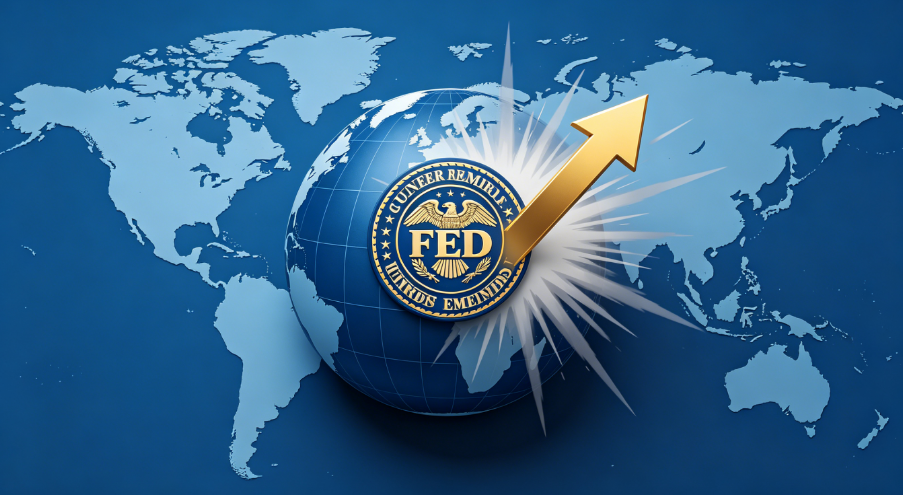
The influence of macroeconomic policies and financial environment on the semiconductor industry cannot be ignored. As shown above, the Vice Chairman of Goldman Sachs recently warned that the Fed may raise interest rates again in autumn to combat stubborn inflation. Higher interest rates will directly increase the capital expenditure costs of semiconductor companies—since fab construction, equipment procurement, and R&D investment often rely on debt financing. For TSMC, with estimated 2024 capital expenditure of $28-32 billion, a 1 percentage point increase in interest rates would add billions of dollars in interest burden. In addition, tightening monetary policy may suppress consumer electronics demand, thereby affecting the prices of cyclical memory and logic chips.
However, from a long-term perspective, structural demand from AI, automotive electrification, IoT, etc., still provides solid support for the semiconductor industry. Investors should focus on the profitability and inventory management capabilities of semiconductor companies in a high-inflation, high-interest rate environment.
V. Emerging Applications and Future Trends
5.1 Artificial Intelligence and High-Performance Computing
The explosion of generative AI (e.g., ChatGPT, Sora, Midjourney) has sent demand for graphics processing units (GPUs) skyrocketing. NVIDIA's H100 and B200 chips are in short supply, driving expansion of TSMC's CoWoS advanced packaging capacity. In the future, more efficient AI chips will shift from general-purpose GPUs to application-specific integrated circuits (ASICs) and neural processing units (NPUs), with more Chiplet designs integrating different functional modules (CPU, GPU, memory, I/O) in a single package.
5.2 Automotive Semiconductors and Electrification
The number of chips used per electric vehicle is about 2-3 times that of a traditional internal combustion engine vehicle, especially in power semiconductors (IGBT, SiC MOSFET), microcontrollers, and sensors. Silicon carbide (SiC) materials, with their high voltage tolerance and low power loss, have become key components for 800V high-voltage fast charging platforms. Manufacturers such as Infineon, STMicroelectronics, and Wolfspeed are actively expanding capacity, but yield and capacity remain challenges.
5.3 Advanced Packaging and Heterogeneous Integration
As process miniaturization becomes more difficult, advanced packaging has become an important way to improve chip performance. TSMC's CoWoS, InFO, and 3D Fabric technologies, Intel's Foveros and EMIB, and Samsung's I-Cube and X-Cube are all dedicated to achieving smaller size, lower latency, and higher bandwidth heterogeneous integration. This also drives market growth for packaging equipment and materials (such as ABF substrates and temporary bonding adhesives).
VI. Supply Chain Resilience and Geopolitical Risks
The rebalancing of the semiconductor supply chain is not only a business decision but also a national security issue. Taiwan, as the world's most advanced wafer foundry and packaging/testing hub, faces Chinese military threats and international pressure. The US and its allies are promoting 'friend-shoring,' encouraging semiconductor companies to set up fabs in Mexico, Eastern Europe, India, etc. However, migrating a supply chain takes 3-5 years or longer, and the transition costs and technology spillover risks are worth evaluating.
Another focus is the export control on ASML's extreme ultraviolet (EUV) lithography equipment in the Netherlands. EUV is essential for producing advanced processes below 7nm and is currently banned from export to China. This fundamentally limits China's progress in advanced processes, but has also spurred China's investment in domestic lithography machines—though breakthroughs are difficult in the short term.
VII. Conclusion
The semiconductor industry is at an unprecedented turning point: technological innovation continues but at a slower pace; market demand continues to expand but with increased structural risks; the globalized supply chain is facing deconstruction, with regionalization and sovereignty consciousness rising. For industry players, only by simultaneously mastering technological leadership, supply chain resilience, and customer partnerships can they stand firm in the next decade.
From an investment perspective, AI-related chips, advanced packaging, automotive semiconductors, and materials/equipment fields have long-term growth potential. Investors should closely monitor the Fed's interest rate policy direction (as mentioned in this article's Goldman Sachs warning), as well as the impact of geopolitical variables on supply chains. For policymakers, how to strike a balance between security and efficiency, avoiding resource misallocation caused by excessive subsidies, will be an important test of wisdom.
Semiconductors—the tiny world made of silicon—will continue to shape humanity's digital future. We are both witnesses and participants. Only by deeply understanding its technology, market, and political dynamics can we seize the opportunity in the wave.