
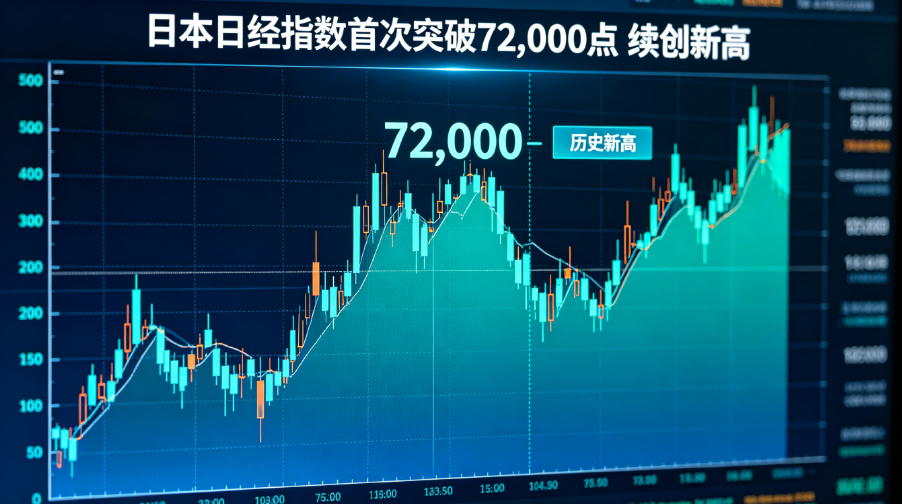
Nikkei 225 Tops 72,000! Is the Japanese Stock Market’s Rally Only Just Beginning?
I nearly spilled my coffee on the screen when I opened my stock trading app this morning—the Nikkei 225 hit another record high! It closed at 72,086.41, up 1.17%, officially breaking the 72,000 milestone. You might think, “What’s all the fuss about? Isn’t hitting new highs normal these days?” But this rally is truly different. This marks the first time the index has ever surpassed 72,000, achieved amid widespread uncertainty over the global economy.
To be honest, watching Japan’s stock market surge higher year after year feels like reading an inspirational manga. Starting in 2023, it broke a 33-year high before charging past 40,000, 50,000 and 60,000, and now it has effortlessly cleared 70,000. Many veteran investors rub their eyes in disbelief: Is this really the same Japan that endured three “lost decades”? The market once written off as a failure of Abenomics? Today, let’s break down what’s fueling this massive rally and how investors should position themselves going forward.
Breaking 72,000: A New Milestone for Japan’s Equities
Let’s start with a quick history lesson. After peaking at 38,957 in December 1989, the Nikkei 225 entered a bear market that lasted more than 30 years. In February 2023, it finally smashed that decades-long ceiling and has run wild ever since. It crossed 40,000 in 2024, hit 60,000 in 2025, and vaulted straight to 72,000 by June 2026. At this pace, hitting 80,000 by year-end is not out of the question.
Yet the numbers only tell part of the story. What makes this breakthrough above 72,000 distinct from previous record runs? In prior years, Japan’s stock gains were driven almost entirely by large-cap blue chips such as Toyota, Sony and Nintendo. Over the past six months, however, the rally has broadened to small and mid-cap firms, semiconductor equipment makers, and even startups. This signals improved market breadth: gains are no longer concentrated in a handful of giants, reflecting broader strength across the entire domestic economy.
Foreign investors have also recorded record net buying activity. Data from the Tokyo Stock Exchange shows offshore investors purchased more than ¥10 trillion of Japanese equities in the first half of 2026, double the figure from the same period in 2025. Why are overseas funds flocking to Japan? The reasons are clear: corporate governance reforms, enhanced shareholder returns, exchange rate stability, and far more reasonable valuations compared to sky-high multiples on U.S. tech stocks.
What’s Behind the Surge? The Key Catalysts Driving the Rally
You may wonder, “Japan’s economy has barely grown for decades—so why is its stock market skyrocketing?” That’s an excellent question. If judged solely by GDP growth, Japan’s performance is modest, clocking in at roughly 1% to 2% annually. Stock markets price in future expectations, not past results, and four pivotal shifts in Japan over recent years have completely rewritten market fundamentals.
1. Tokyo Stock Exchange’s Corporate Governance Reforms Deliver Tangible Results
Since 2023, the TSE has mandated all listed companies disclose plans to improve capital efficiency and lift price-to-book ratios (PBR) above 1x. While this sounds bureaucratic on paper, its real-world impact has been transformative. Countless firms launched share buybacks, raised dividends, and divested non-core assets. Corporations shifted from hoarding cash to rewarding shareholders—a dynamic foreign investors overwhelmingly favor.
2. Semiconductor and AI Tailwinds Lift Japan’s Tech Sector
TSMC’s new plant in Kumamoto, Rapidus’ 2-nanometer facility in Hokkaido, and overflowing order books for equipment suppliers like Tokyo Electron and Disco have supercharged the sector. Japan has long held global dominance in semiconductor materials and manufacturing hardware, and the AI boom has sent these firms’ earnings soaring.
3. The Double-Edged Sword of a Weak Yen
A depreciated yen pushes up import costs, yet delivers massive upside for export-heavy conglomerates. Overseas profits booked by Toyota, Honda, Sony and others balloon when converted back to Japanese currency. The persistently cheap yen also lets foreign investors acquire Japanese assets at a discount, creating a self-reinforcing positive cycle.
4. Gradual, Measured Tightening by the Bank of Japan
Many assume rate hikes hurt equities, but the BOJ has handled normalization masterfully: slow, incremental adjustments without aggressive tightening, giving markets ample time to adapt. Japanese interest rates remain far below those in Europe and the U.S., ensuring abundant liquidity stays in the system.
What Comes After Historic Highs?
Every time the index hits a new peak, investors ask: “Is it too late to buy?” This is largely a psychological hurdle. Anyone who held Japanese stocks since 1990 and waited 30 years to break even will naturally view current levels as expensive. For investors with a five- to ten-year horizon, valuations remain far from bubble territory.
The Nikkei 225 currently trades at around 16 times earnings, versus over 22 times for the S&P 500. Even against Japan’s own history, the bubble-era peak in 1989 saw multiples exceed 60x, making today’s valuations look tame by comparison. Admittedly, Japan’s long-term corporate growth rates lag those of the U.S., but accounting for reform dividends and rising shareholder payouts, a P/E range of 15 to 18x represents a reasonable new normal.
Significant risks remain, however. The biggest threat is a U.S. hard landing: a deep American recession would drag down global equities, with Japan no exception. Domestic structural headwinds including labor shortages and an aging population have no quick fixes. Additionally, a sharp yen appreciation—potentially forced by BOJ rate hikes to fight inflation—would crimp export manufacturers’ profitability.
From an investment strategy perspective, picking sectors beats timing market tops and bottoms. Semiconductor equipment, factory automation, financials (benefiting from higher interest rates), and consumer brands with pricing power offer solid long-term upside. For conservative investors, Nikkei ETFs or TSE index tracking funds provide simple, diversified exposure.
Retail and Institutional Investors: Staying Grounded Amid the Euphoria
Many Taiwanese investors hold Japanese equities as a defensive satellite allocation. The market’s outsized returns in recent years have turned Japan into one of their most profitable portfolio segments. Several friends of mine loaded up on Japanese REITs and Nikkei ETFs last year, earning returns above 30%. This dynamic carries a critical psychological trap: mistaking short-term momentum for permanent long-term growth.
Japan’s stock market delivers an average annual return of roughly 5% to 8%. The extraordinary gains of the past two years stem from a catch-up rally layered atop reform dividends. Once these one-time catalysts fade, growth will revert to its baseline pace. Anyone chasing highs now should set clear profit-taking targets or build positions gradually via regular dollar-cost averaging.
Don’t overlook currency risk either. Taiwanese investors purchasing Japanese stocks bear yen exchange rate swings alongside equity price moves. Yen appreciation boosts overall returns when converting back to TWD; sustained yen depreciation can erase stock gains once converted into local currency.
Closing Thoughts: An Era of Opportunity That Calls for Patience
Beyond the headline milestone of 72,000, the Nikkei’s breakout encapsulates a generational shift. After three lost decades, Japan has unlocked fresh growth drivers through corporate overhaul, tech investment and supportive policy. Warren Buffett’s heavy purchases of Japanese trading houses are no accident—smart global capital is reallocating toward Japanese assets en masse.
For everyday investors, fixating on daily market swings matters far less than building a systematic investment framework: defining position sizes, target sectors and rebalancing rules beats guessing tomorrow’s highs or lows. Remember: markets rarely wait for you to feel fully ready before advancing, but staying invested ensures you can capture long-term upside.
Next time the Nikkei hits another record, resist the urge to simply marvel at the number. Instead, ask yourself: Does my portfolio include Japanese exposure? If not, it may be time to consider it. If you already hold positions, enjoy the rally—but stay vigilant, and don’t overextend your exposure.