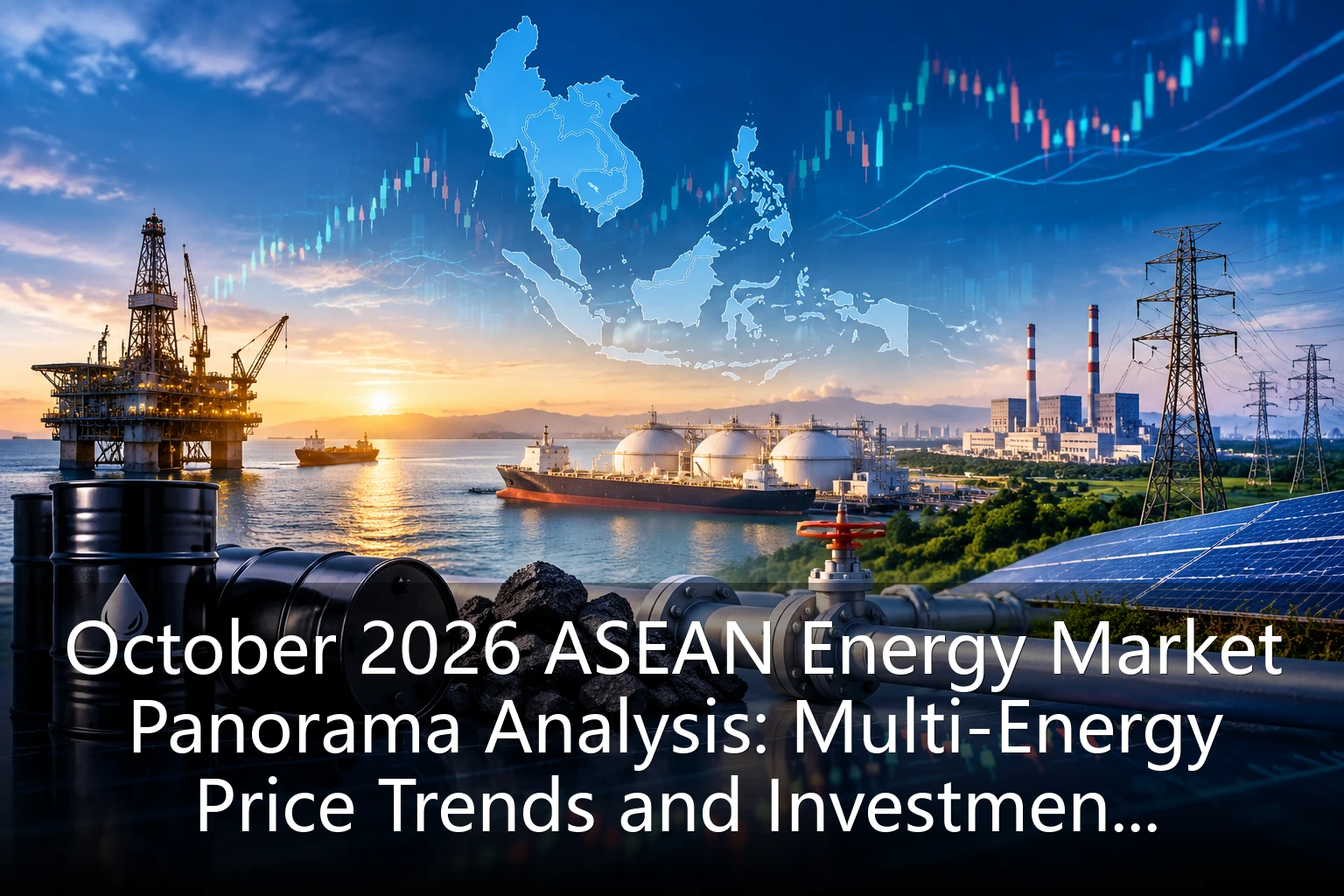
October 2026 ASEAN Energy Market Panorama: Multi-Energy Price Volatility and New Investment Opportunities
\nIn early October 2026, the ASEAN region's energy market presented a diversified fluctuation pattern, with significant divergences in price trends across the four major energy sectors: crude oil, natural gas, coal, and electricity. This reflects multiple factors including uneven global economic recovery, changes in regional supply-demand structures, and geopolitical influences. As a professional investment information portal for the ASEAN region, this article will conduct an in-depth analysis of current energy market dynamics, interpret the driving factors behind price fluctuations, and provide forward-looking investment strategy recommendations for investors.
\n\nCrude Oil Market: Price Volatility Under Supply-Demand Rebalancing
\nSince entering October, the ASEAN region's crude oil market has shown an upward fluctuation trend. Brent crude oil futures prices climbed from $78 per barrel at the beginning of the month to the $82 per barrel range, an increase of over 5%. This trend was mainly influenced by multiple factors including continuous OPEC+ production cuts, stronger-than-expected global demand recovery, and geopolitical tensions in the Middle East.
\n\nFrom the supply perspective, the September meeting of OPEC+ countries decided to extend production cuts to the first quarter of 2026, with some countries exceeding their promised reduction levels, leading to tighter global crude oil supply. Meanwhile, the growth of US shale oil production has slowed, and the hurricane season in the Gulf of Mexico has caused short-term disruptions to production activities, further exacerbating supply tightness.
\n\nOn the demand side, the Asian economic recovery shows strong momentum, with manufacturing PMI in China and India continuing to expand, driving steady growth in crude oil demand. Refinery operating rates in the ASEAN region have remained above 85%, supporting regional crude oil demand. However, slower economic growth in Europe and improved energy efficiency in the US have somewhat constrained global crude oil demand growth.
\n\nRegarding geopolitical factors, escalating shipping security risks in the Strait of Hormuz and ongoing tensions in the Middle East have both supported the crude oil market. Additionally, the weakening US dollar has made dollar-denominated crude oil cheaper for holders of other currencies, stimulating buying demand.
\n\nLooking ahead to the fourth quarter, the crude oil market is expected to maintain an upward fluctuation trend, but risks such as OPEC+ policy adjustments, weaker-than-expected global economic recovery, and a rebound in the US dollar should be monitored. For investors, it is recommended to focus on investment opportunities such as crude oil ETFs, energy sector stocks, and crude oil futures, while implementing proper risk management.
\n\nNatural Gas Market: Asian LNG Prices Hit New High for the Year
\nIn early October 2026, Asian liquefied natural gas (LNG) prices continued to rise, with the JKM (Japan Korea Marker) price breaking through $22/MMBtu, reaching a new high for the year. This price level represents an increase of about 15% since early September, mainly driven by multiple factors including supply tightness, strong demand, and geopolitical risks.
\n\nIn terms of supply, global LNG supply growth has fallen short of expectations. Some Australian LNG projects experienced production declines due to equipment maintenance, some US LNG export facilities were temporarily closed due to hurricanes, and Qatar, the world's largest LNG exporter, has seen slow progress in its capacity expansion plans due to infrastructure limitations. Additionally, Europe has increased LNG imports to meet winter energy demand, intensifying global LNG market competition.
\n\nOn the demand side, natural gas demand in Asia continues to grow. To advance its "dual carbon" goals, China has increased the proportion of natural gas in its energy structure, with LNG imports growing by about 12% year-on-year. Gas power generation demand in India, South Korea, and Southeast Asian countries is also strong, supporting the LNG market. Particularly as winter approaches, rising heating demand in the Northern Hemisphere will further push up natural gas prices.
\n\nRegarding geopolitical factors, the ongoing Russia-Ukraine conflict continues to affect European gas supply patterns, prompting Asian buyers to shift to the LNG market and driving up prices. Additionally, increased shipping security risks in the Red Sea have raised LNG transportation costs, indirectly pushing up terminal prices.
\n\nFor natural gas market investments, it is recommended to focus on investment opportunities in areas such as LNG carriers, natural gas equipment manufacturers, and gas power generation companies. At the same time, derivative instruments such as natural gas futures and options can be considered for risk hedging.
\n\nCoal Market: Price Divergence Under Changing Supply-Demand Structure
\nIn October 2026, the ASEAN region's coal market showed a price divergence trend. Thermal coal prices remained stable with slight increases, while coking coal prices declined somewhat. This trend reflects the differences in supply-demand structures for different coal types against the backdrop of global energy structure transformation.
\n\nFor thermal coal, prices of high-quality Kalimantan thermal coal (Index 5500) in Indonesia increased from $95/ton at the beginning of September to $98/ton, an increase of about 3%. This was mainly driven by strong demand from major importing countries like China and India, as well as tightening Indonesian export policies. The Indonesian government announced in October that coal export quota (RKAB) approvals would be stricter to ensure sufficient domestic power supply, leading to tighter market supply.
\n\nThe coking coal market, however, showed weakness, with Peak Downs coking coal prices in Australia falling from $220/ton at the beginning of September to $210/ton, a decrease of about 4.5%. Slowing demand in the global steel industry, particularly China's crude steel production control policies, has weakened coking coal demand. Additionally, steel capacity expansion in emerging markets like Brazil and India has fallen short of expectations, further suppressing coking coal demand.
\n\nFrom a regional market perspective, the coal trade pattern within ASEAN is changing. Countries like Vietnam and Thailand are reducing their dependence on Australian coking coal, instead increasing domestic coal purchases from Indonesia to reduce transportation costs and supply chain risks. Meanwhile, coal production in Southeast Asian countries like Laos and Myanmar is steadily growing, making regional coal trade increasingly active.
\n\nLooking ahead, as global energy transformation accelerates, the coal market will face structural adjustments. Thermal coal may maintain relative strength in the short term, while the coking coal market faces long-term downward pressure. Investors can focus on investment opportunities in clean coal technology and efficient coal utilization, while being alert to uncertainties from policy risks and environmental pressures.
\n\nElectricity Market: Price Fluctuations Under Supply-Demand Tightness
\nIn October 2026, the ASEAN region's electricity market faces seasonal peak demand, with electricity prices showing an upward trend in many areas. Electricity prices in Vietnam, Thailand and other countries have increased by about 5-8% compared to the previous month, reflecting regional electricity supply-demand tightness.
\n\nIn terms of demand, as temperatures drop, both residential and commercial electricity demand have risen. In northern Vietnam, lower temperatures have increased residential heating electricity demand; in Thailand, industrial electricity demand is strong due to economic recovery. Additionally, the rapid development of high-power-consuming industries such as data centers and cryptocurrency mining farms has also pushed up regional electricity demand.
\n>\nOn the supply side, hydropower generation has decreased due to seasonal factors. In northern Vietnam's Lao Cai and Lai Chau provinces, hydropower output has decreased by about 15% due to reduced rainfall; in northern Thailand, low reservoir water levels have limited hydropower generation. At the same time, some natural gas power generation units have been offline for equipment maintenance, further exacerbating electricity supply tightness.
\n\nFrom the perspective of regional electricity market integration, ASEAN's power grid interconnection projects continue to advance. The Laos-to-Guangdong-Hong Kong-Macao Greater Bay Area hydropower direct supply project has achieved stable power supply, helping to alleviate regional electricity supply-demand imbalances. However, problems such as lagging power grid infrastructure and imperfect regional electricity market mechanisms still constrain the efficient allocation of power resources.
\n\nRegarding electricity price trends, high volatility is expected to continue in the fourth quarter. As winter electricity demand peaks, electricity prices may rise further. Investors can focus on investment opportunities in new energy generation, smart grids, and energy storage technologies, while being alert to risks from electricity price fluctuations.
\n\nEnergy Investment Strategy: Seizing Diversified Investment Opportunities
\nFacing the complex landscape of the ASEAN energy market in October 2026, investors should adopt diversified investment strategies to seize investment opportunities in different energy types while implementing proper risk management.
\n\nFirst, from an asset allocation perspective, it is recommended that investors maintain appropriate allocation of energy assets in their portfolios, but dynamically adjust the proportion based on market performance of different energy types. Traditional energy sources like crude oil and natural gas still have investment value in the short term, while the new energy sector has long-term growth potential.
\n\nSecond, from an investment perspective, investors can participate in the energy market through various channels. Direct investment in financial products such as energy futures and ETFs can yield returns from market fluctuations; investing in quality enterprises along the energy industry chain, such as oil companies, natural gas producers, and new energy technology providers, allows sharing of industry growth dividends; investing in energy infrastructure projects such as pipelines and energy storage facilities can provide stable cash flow returns.
\n\nThird, from a risk management perspective, investors should closely monitor risk factors such as geopolitical risks, policy changes, and price fluctuations, and adopt measures like diversification and hedging strategies to reduce risks. At the same time, pay attention to energy transformation trends and seize investment opportunities in new energy and clean technologies to achieve long-term sustainable development of the investment portfolio.
\n\nFinally, from a regional perspective, the ASEAN energy market has unique investment value. Energy demand in the region continues to grow, there is ample space for energy infrastructure construction, and the energy transformation process provides a broad market for clean energy technologies. Investors can focus on changes in ASEAN countries' energy policies, progress in regional electricity market integration, and investment opportunities in new energy projects.
\n\nConclusion: New Investment Landscape Under Energy Transformation
\nThe ASEAN energy market in October 2026 shows characteristics of multi-energy price divergence and supply-demand structure transformation, reflecting the complexity and diversity of the global energy structure transformation process. Different energy types such as crude oil, natural gas, coal, and electricity face different market opportunities and challenges, and investors need to formulate differentiated investment strategies based on their own risk preferences and investment objectives.
\n\nLooking ahead, as the global carbon neutrality process accelerates, the energy market will face profound changes. Traditional energy will continue to occupy an important position for a considerable period, but new energy and clean technologies will gradually rise, reshaping the energy market landscape. Investors should closely follow energy transformation trends, seize investment opportunities in different energy types at various development stages, and achieve long-term steady growth of the investment portfolio.
\n\nFor the ASEAN region, the energy market faces both challenges and opportunities. Energy demand in the region continues to grow, there is ample space for energy infrastructure construction, and abundant energy resources provide a favorable environment for energy investment. At the same time, ASEAN countries are actively promoting energy transformation and developing clean energy, providing a broad market for new energy technologies and services. Investors can focus on changes in ASEAN countries' energy policies, progress in regional energy cooperation, and investment opportunities in new energy projects to capture the development dividends of the ASEAN energy market.