
Semiconductor Industry at a Crossroads: Deep Analysis of AI Capital Shift and Chip Stock Volatility
Keywords
Semiconductor, Artificial Intelligence, Capital Shift, Chip Stocks, Jensen Huang, Industry Structure, AI Infrastructure
Introduction
Semiconductors, one of the greatest inventions of the 20th century, have long penetrated every capillary of modern society. From smartphones to cloud data centers, from autonomous vehicles to medical diagnostic equipment, chips are like the "oil" of the digital age, driving the operation of human civilization. However, in recent years, the global semiconductor industry is facing an unprecedented reshuffle: the explosive growth of artificial intelligence (AI) has not only reshaped end demand but also triggered violent fluctuations in the capital market. When Jensen Huang (Nvidia founder and CEO) repeatedly emphasizes in public that "the iPhone moment of AI has arrived," investor frenzy and subsequent chip stock crashes reveal deep contradictions within this industry. This article will start from the structural changes of the semiconductor industry, analyze how AI capital shift is stirring the global chip market, and explore key development trends for the coming years.
I. Structural Characteristics and Current Landscape of the Semiconductor Industry
The semiconductor industry is not monolithic but a precision value chain consisting of design, manufacturing, and packaging and testing. For a long time, this industry has steadily advanced according to the rhythm of "Moore's Law": transistor density doubles every two years, and cost halves. However, as process miniaturization approaches physical limits, the R&D and fab construction costs for advanced processes have soared, with only a few giants like TSMC, Samsung, and Intel able to afford mass production of processes below 3nm. Meanwhile, the end market is highly differentiated: consumer electronics (phones, PCs) growth slows, while data centers, automotive electronics, and IoT become new growth poles.
Against this background, the rise of AI is like a boulder thrown into a calm lake. GPU manufacturers represented by NVIDIA, with their CUDA ecosystem and parallel computing advantages, have become the standard hardware for AI training and inference. Market forecasts show that the AI chip market size will exceed $150 billion in 2026, with NVIDIA accounting for over 80% of the share. This wave not only pushed NVIDIA's market value to over $3 trillion at one point but also forced traditional semiconductor giants like Intel and AMD to re-examine their product roadmaps.
II. AI Capital Shift: From "General-Purpose Computing" to "Specialized Acceleration"
The core of AI capital shift is that industrial capital is flowing massively from traditional general-purpose CPU systems to specialized accelerators (such as GPUs, ASICs, FPGAs, NPUs). This shift is not accidental but determined by the nature of deep learning algorithms: neural network training and inference require a large number of matrix multiplications and parallel computations, while the serial architecture of CPUs is far less efficient.
Jensen Huang pointed out at the 2024 GTC conference: "We are witnessing a new computing model—accelerated computing. The growth rate of traditional CPUs can no longer keep up with the explosion of data volume. Only specialized hardware can support the development of generative AI." This statement directly drove capital's pursuit of AI chip companies. Venture capital data shows that between 2023 and 2025, over 60% of global semiconductor venture capital flowed to AI chip startups, from Cerebras to Groq, from SambaNova to Tenstorrent, each trying to break through NVIDIA's monopoly.
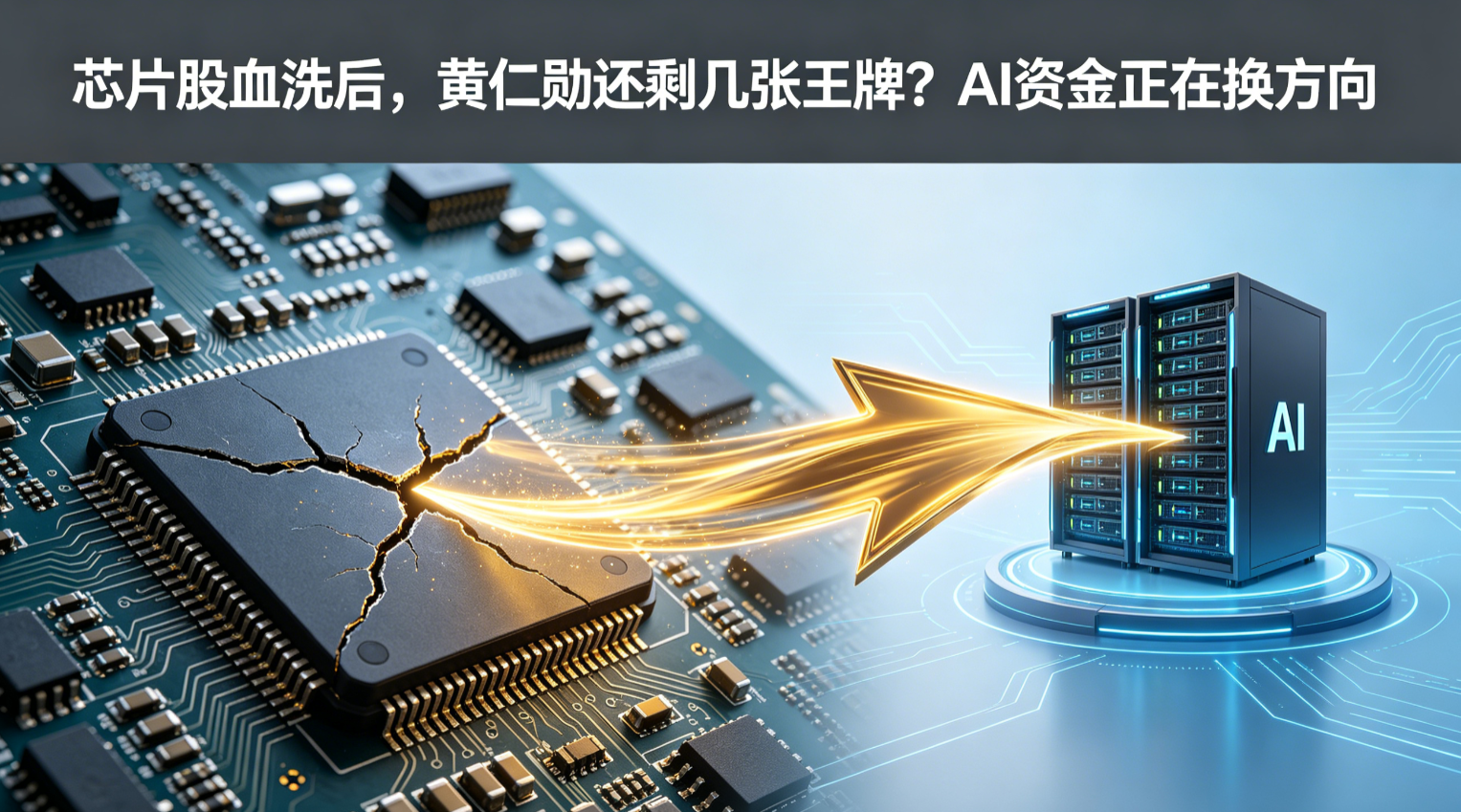
However, excessive capital concentration also brings concerns. When massive funds flood into AI infrastructure (such as GPU servers, data centers), investment in traditional semiconductor fields (such as memory, analog chips, automotive chips) relatively shrinks, leading to supply-demand imbalances. In the second half of 2025, DRAM prices fell sharply due to weak automotive and industrial demand, while AI-related high-bandwidth memory (HBM) was in short supply with high prices. This structural differentiation is a direct consequence of capital shift.
III. Chip Stock Crash: Bubble or Correction?
In the second quarter of 2026, global semiconductor stocks experienced a sharp pullback. NVIDIA's stock price fell more than 30% in three months, with AMD, Intel, and TSMC also dropping 15% to 25%. Market sentiment shifted from extreme optimism to panic. Investors began to doubt: is the demand for AI chips overhyped? Are data center constructions repetitive investments?
In-depth analysis reveals at least three layers of logic behind this crash. First, macroeconomic uncertainty: expectations of the Federal Reserve maintaining high interest rates continue to suppress tech stock valuations, and semiconductors, as a high-growth, high-volatility industry, suffer the most. Second, supply chain inventory adjustment: although AI server orders are strong, some customers (such as cloud service providers) began to slow down procurement after large-scale stockpiling in 2024-2025, leading to short-term supply-demand mismatch. Third, changes in competitive landscape: AMD's MI300 series GPUs and Intel's Gaudi series accelerators are gradually eroding market share, challenging NVIDIA's dominant position.
Notably, after the crash, Jensen Huang publicly stated: "I never believe that the market's demand for AI is overestimated, but capital markets always have irrational volatility. The real demand comes from digital transformation across thousands of industries, which is a trend that will last for decades." His remarks attempted to reassure investors but indirectly acknowledged short-term overheating. In fact, from an industry fundamental perspective, the long-term growth logic of AI chips has not changed: generative AI applications are penetrating into healthcare, finance, manufacturing, education, and other fields, each requiring dedicated inference chips. But whether the speed of this penetration can support current capital pricing remains to be seen.
IV. Future Outlook: Three Major Trends in the Semiconductor Industry
(I) Rise of System-Level Integration and Chiplet Technology
As Moore's Law slows down, chip design shifts from merely pursuing process miniaturization to heterogeneous integration. Chiplet technology allows packaging chips from different processes and functions (such as CPU, GPU, memory) on the same substrate in a modular way to improve performance. This not only reduces the cost of advanced processes but also provides flexible combination solutions for AI accelerators. Advanced packaging technologies such as Intel's Foveros and TSMC's CoWoS will become key to the next phase of competition.
(II) Geopolitics and Supply Chain Restructuring
The semiconductor industry has become a focus of major power competition. The US CHIPS and Science Act, the EU European Chips Act, Japan's "Semiconductor Revitalization Plan," and China's self-sufficient chip strategy are all driving localizing and diversifying supply chains. However, this "de-globalization" trend also increases supply chain redundancy costs. For economies dependent on semiconductor exports like Taiwan and South Korea, how to balance efficiency and security will be a severe test.
(III) Sustainable Development and Green Computing
The training power consumption of AI models is staggering: training a large language model of GPT-4 level requires hundreds of megawatt-hours of electricity, generating thousands of tons of carbon emissions. As ESG (Environmental, Social, Governance) pressure rises, semiconductor companies are forced to take energy efficiency as a core metric. NVIDIA has begun promoting technologies like "sparse computing" and low-precision training; TSMC has introduced renewable energy and carbon capture facilities. Future chip design will not only pursue computing power improvement but also consider performance per watt and full lifecycle carbon footprint.
Conclusion
The semiconductor industry is standing at a historical crossroads. The capital shift caused by AI, on one hand, injects unprecedented momentum into the industry, pushing the boundaries of computing power; on the other hand, it brings short-term volatility, structural imbalances, and geopolitical risks. For investors, understanding the long-term trend from "general-purpose computing" to "specialized acceleration" is more important than predicting short-term stock prices. For industry practitioners, only by embracing system-level innovation, localized production, and sustainable development can they remain invincible in this uncertain era.
As Jensen Huang said: "AI is not a bubble; it is a new industrial revolution." And semiconductors are the engine of this revolution. The operation of this engine will determine the digital destiny of humanity for the next decade.