Capital Layout of the Semiconductor Industry: Dual Drive of Red Chips and H Shares
Introduction
As the core pillar of modern electronic information technology, the semiconductor industry can be called "industrial food," and its strategic position is self-evident. From smartphones to artificial intelligence, from cloud computing to the Internet of Things, semiconductor chips penetrate every high-tech field. However, the semiconductor industry requires huge R&D investments, extremely high technical barriers, and long return cycles. To achieve leapfrog development, companies cannot do without strong capital market support. For Chinese semiconductor companies, choosing the right listing path in the global capital market, especially distinguishing between red chips and H shares as two distinct financing models, has become a key issue determining future corporate competitiveness. This article will deeply explore the capital layout of the semiconductor industry, analyze the conceptual differences between red chips and H shares, and examine their deep impact on semiconductor enterprise development.

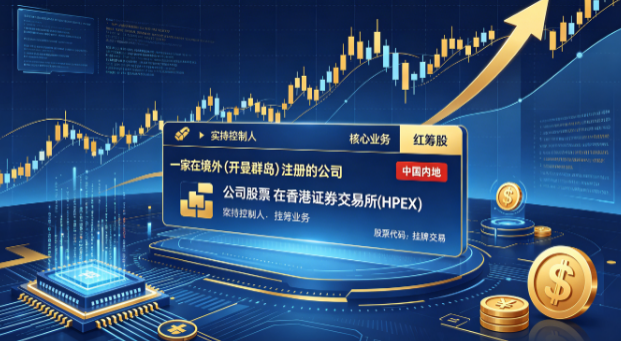
Image description: Red chips and H shares, as two mainstream structures for Chinese enterprises going overseas, have significant differences in capital regulation, ownership structure, and market positioning.
Capital Needs and Financing Difficulties in the Semiconductor Industry
The semiconductor industry is a typical high-capital-intensive industry. According to industry statistics, the construction cost of an advanced 12-inch wafer fab often exceeds tens of billions of dollars, and as each generation of process advances, the investment scale grows exponentially. For example, TSMC's R&D and mass production investment for its 3nm process exceeded $20 billion. Chinese semiconductor companies, in the process of catching up with international advanced levels, also face huge funding gaps.
Traditional bank loans are difficult to meet the long-cycle, high-risk capital needs of semiconductor companies; venture capital can provide early support, but it is insufficient for mid-to-late-stage capacity expansion and technology iteration. Therefore, going public has become the best path for semiconductor companies to obtain long-term capital, enhance brand reputation, and attract international cooperation. However, due to restrictions on unprofitable companies and special ownership structures in the A-share market in the past, many semiconductor companies chose to list in Hong Kong or the US. Among them, the Hong Kong Stock Exchange, with its international platform and continuously reformed listing rules, has attracted a large number of semiconductor companies to list through red chip or H share structures.
Conceptual Differentiation of Red Chips and H Shares
Although red chips and H shares are both listed in Hong Kong, they have fundamental differences in legal nature, regulatory framework, and equity liquidity. Red chips refer to companies incorporated overseas (such as the Cayman Islands, Bermuda, etc.), controlled by mainland Chinese capital, with main business in the mainland. Their shares are fully tradable and not subject to mainland capital account controls. Typical red chips include China Mobile and Lenovo. H shares, on the other hand, refer to companies incorporated in mainland China, approved by the China Securities Regulatory Commission, and listed in Hong Kong. Their shares are divided into domestic shares (non-tradable) and H shares (tradable), with domestic shares unable to be freely converted into H shares, leading to a liquidity predicament of same share different rights.
For semiconductor companies, the advantage of the red chip structure lies in its flexible ownership structure, allowing for dual-class share structures (AB shares), which helps founding teams maintain control after financing. Additionally, red chip shares are fully tradable in international markets, facilitating subsequent rights issues and equity incentives. H shares, on the other hand, must comply with dual regulation from mainland China and Hong Kong, with a relatively lengthy listing approval process, and domestic shares cannot be traded on the secondary market, potentially leading to valuation discounts. However, H shares also have unique advantages such as mainland policy support and a direct transfer channel to the A-share market (e.g., H share "full circulation" pilot).
Strategic Considerations for Semiconductor Companies Choosing Red Chips or H Shares
R&D Investment and Equity Incentive Needs
The core assets of semiconductor companies are talent and technology. Under the red chip structure, companies can establish international-standard employee stock ownership plans and option pools without being subject to mainland foreign exchange controls, attracting overseas high-end talent to return. For example, after delisting from the NYSE in 2019, SMIC considered returning to A-share as a red chip but ultimately chose the STAR Market; while Hua Hong Semiconductor listed in Hong Kong as an H share, its equity incentive plan requires mainland regulatory approval, offering relatively lower flexibility. For many chip design companies in a loss stage requiring long-term investment (such as AI chip startups), the red chip structure is more conducive to leveraging international capital market tolerance.
Geopolitical and Compliance Risks
In recent years, with the intensification of US-China technology competition, the US Department of Commerce has frequently added Chinese semiconductor companies to the "Entity List," causing some red chips to suffer sanctions risks and sharp stock price fluctuations. For example, after SMIC, as a red chip (incorporated in the Cayman Islands), faced supply chain restrictions, its H share (Hong Kong stock code 0981) immediately reflected the negative news. However, companies under the red chip structure can circumvent some sanctions through organizational restructuring, while H share companies, being subject to mainland law, may be passive in handling overseas lawsuits. Companies need to weigh the legal risks of the two structures based on the degree of internationalization of their business.
Valuation and Market Perception
H shares have long experienced a "discount" phenomenon (i.e., H share prices are lower than the implied value of corresponding A-share domestic shares), but in recent years, with the improvement of the Shenzhen-Hong Kong and Shanghai-Hong Kong Stock Connect mechanisms, some high-quality H shares (such as Hua Hong Semiconductor, SMIC H shares) have gained favor from northbound funds, with valuations gradually recovering. Red chips, due to their fully tradable nature, have prices closer to the valuation logic of international peers and are easily included in MSCI and other international indices, attracting passive fund allocation. However, the regulatory environment for red chips is relatively loose, and some companies may face short seller attacks due to insufficient information transparency.
Case Studies: From SMIC to Hua Hong Semiconductor
Taking China's wafer foundry leader SMIC as an example, its ownership structure is extremely special: it has both RMB ordinary shares (A shares) listed on the STAR Market and H shares listed in Hong Kong, while its actual controller indirectly holds shares through an overseas red chip entity. This "red chip + H share" hybrid model reflects the company's repeated balancing between policy and market. In 2020, SMIC returned to the STAR Market, raising 53.2 billion RMB for advanced process R&D, effectively easing capital pressure. However, following US sanctions, procurement of equipment for processes below 14nm was blocked, putting huge pressure on its stock price. This shows that even with a flexible capital structure, geopolitical risks cannot be completely avoided.
In contrast, Hua Hong Semiconductor adheres to a pure H share model, with its domestic shares held by Shanghai Hua Hong Group, without seeking an A-share listing. Hua Hong focuses on specialty processes (such as power semiconductors, embedded non-volatile memory), leveraging mainland market demand for stable growth. In 2023, Hua Hong Semiconductor had a secondary listing on the STAR Market (i.e., H back to A), becoming one of the few semiconductor companies with both H and A shares. This path retains the international financing capability of H shares while increasing mainland investor participation through A shares, providing a reference for other semiconductor companies.
Conclusion and Outlook
The future competition of the semiconductor industry is essentially a dual race between capital and technology. Red chips and H shares, as two main paths for Chinese semiconductor companies to access international capital markets, each have their pros and cons, with no absolute superiority. The red chip structure gives companies more agile equity operation space and international vision but requires bearing higher compliance externalities; H shares provide policy protection and convenient connection to the mainland market but may face liquidity and valuation discount challenges.
Looking ahead, with the Hong Kong Stock Exchange continuously optimizing listing rules (such as adding Chapter 18C for specialist technology companies) and the mainland promoting the expansion of the H share full circulation pilot, the boundaries between the two structures will gradually blur. Semiconductor companies should flexibly combine red chip and H share strategies based on their own technology stage, market positioning, and shareholder structure, and even explore innovative models such as "red chip + H + A" multi-listing. Only in this way can they seize the initiative in global semiconductor competition and truly achieve a leap from "chip catching up" to "chip leading."
(Approximately 1,844 words total)